Topic: The Changing Landscape of Marriage in the US: Trends and Insights
Over the past two decades, the institution of marriage in the US has undergone significant transformations. Various factors such as shifting societal norms, economic conditions, and educational attainments have played critical roles in shaping these changes. This article delves into the marriage rates from 2000 to 2020, examining key trends, demographic shifts, and influencing factors.

General Trends in Marriage Rates
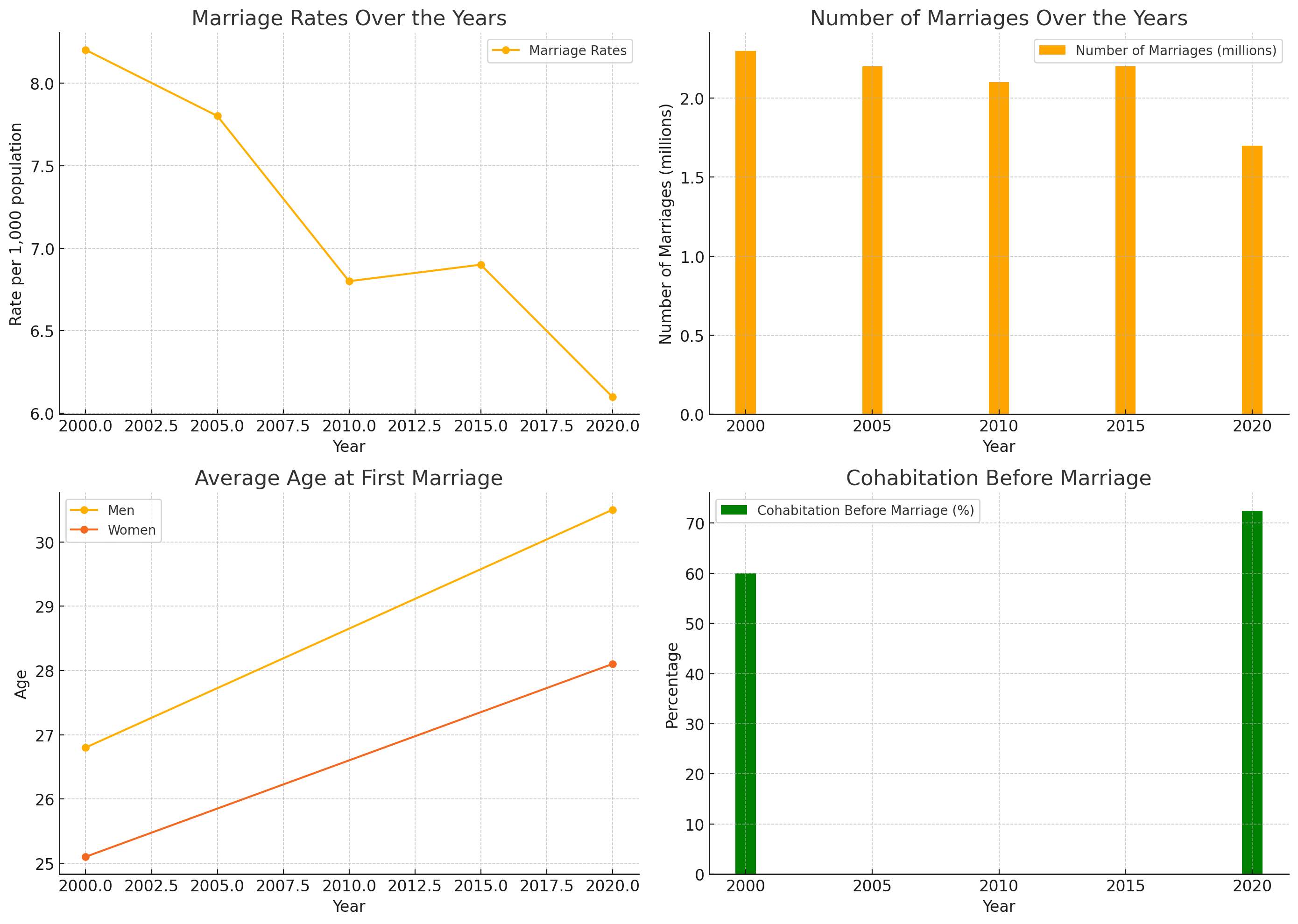
The overall marriage rate in the U.S. has been on a gradual decline over the past 20 years. In 2000, the marriage rate stood at approximately 8.2 per 1,000 population. However, by 2020, this rate had decreased to around 6.1 per 1,000 population. This downward trend reflects broader societal changes and evolving attitudes towards marriage.
- 2000: 2.3 million marriages (8.2 per 1,000 population)
- 2005: 2.2 million marriages (7.8 per 1,000 population)
- 2010: 2.1 million marriages (6.8 per 1,000 population)
- 2015: 2.2 million marriages (6.9 per 1,000 population)
- 2020: 1.7 million marriages (6.1 per 1,000 population)
Rising Marriage Age
One of the most notable trends is the increasing age at first marriage. In 2000, the average age for first-time grooms was around 26.8 years, and for brides, it was 25.1 years. By 2020, these averages had risen to about 30.5 years for men and 28.1 years for women. This shift indicates a broader trend of individuals prioritizing career and personal development before settling down.
Cohabitation Before Marriage
Cohabitation before marriage has become more common, with a significant rise in the number of couples living together before tying the knot. In the early 2000s, about 60% of couples cohabited before marriage. This figure increased to around 70-75% by 2020, reflecting changing social norms and attitudes towards premarital cohabitation.
Educational Influence on Marriage
Education plays a crucial role in marital trends. Individuals with higher education levels are more likely to get married and stay married. The marriage rate among college graduates has remained relatively stable, while it has declined more sharply among those without a college degree. This disparity highlights the influence of economic stability and career prospects on marital decisions.
The Impact of Economic Stability and Employment Prospects on Marriage Rates
Economic stability and employment prospects play crucial roles in influencing marriage rates. Financial security is often a prerequisite for marriage, as couples consider their economic readiness to support a household and potential future children. Historical data highlights how economic fluctuations, such as the Great Recession of 2007-2009, significantly affect marriage rates.
The Great Recession and its Aftermath
The Great Recession, which spanned from December 2007 to June 2009, had profound impacts on various aspects of American life, including marriage rates. During this period, the U.S. economy experienced significant downturns, with widespread job losses, home foreclosures, and economic uncertainty.
- Decline in Marriage Rates: The economic instability of the Great Recession saw a notable dip in marriage rates. In 2007, just before the recession, the marriage rate was approximately 7.3 per 1,000 population. By 2010, as the country was beginning to recover, this rate had dropped to 6.8 per 1,000 population. The economic uncertainty led many couples to postpone marriage until they could achieve more stable financial footing.
- Financial Considerations: Financial stress, including unemployment and loss of income, made marriage less feasible for many. The costs associated with weddings, establishing a household, and potential child-rearing were significant deterrents for couples facing economic hardship.
Post-Recession Recovery
As the economy began to recover post-2009, marriage rates showed signs of stabilization, though they did not return to pre-recession levels. This partial recovery suggests that while improved economic conditions can encourage marriage, other long-term societal trends also play a role in declining marriage rates.
- Gradual Recovery: From 2010 to 2015, the marriage rate saw a slight increase from 6.8 to 6.9 per 1,000 population. This period of recovery indicates that as employment prospects improved and financial stability returned, more couples felt confident in taking the step towards marriage.
- Persistent Decline: Despite the recovery, the overall trend over the past two decades has been a decline in marriage rates. By 2020, the marriage rate had fallen to 6.1 per 1,000 population. This suggests that while economic factors are influential, they interact with other social and cultural dynamics that continue to shape marriage trends.
Long-Term Trends and Economic Factors
Beyond the immediate impact of economic crises, long-term trends in employment and financial security continue to influence marriage rates.
- Employment Prospects: Steady employment and positive career prospects encourage marriage by providing financial security and confidence in the future. Regions with robust job markets and higher average incomes tend to have higher marriage rates, as financial readiness is a key factor in the decision to marry.
- Educational Attainment: Higher levels of education are associated with greater economic stability and higher marriage rates. College graduates often have better employment opportunities and financial resources, making them more likely to marry and stay married compared to those with lower educational attainment.
- Economic Inequality: Growing economic inequality can also influence marriage rates. As the economic gap widens, individuals from lower socioeconomic backgrounds may find marriage less attainable or desirable due to financial instability.
Sociocultural Factors
While economic factors are significant, they do not operate in isolation. Sociocultural shifts, such as changing attitudes towards marriage, cohabitation, and individualism, also contribute to the long-term decline in marriage rates.
- Changing Norms: Increasing acceptance of cohabitation and non-traditional family structures allows couples to build committed relationships without formal marriage. This trend is particularly prevalent among younger generations who may prioritize personal and professional development over traditional marital timelines.
- Delaying Marriage: Many individuals are choosing to marry later in life as they focus on education, career, and personal goals. This delay, while contributing to the overall decline in marriage rates, also reflects changing life priorities and economic strategies.
Economic stability and employment prospects significantly impact marriage rates, with periods of economic downturn, like the Great Recession, leading to notable declines. While economic recovery can stabilize and slightly increase marriage rates, the long-term trend towards declining marriage rates is influenced by a complex interplay of financial, educational, and sociocultural factors. Understanding these dynamics is essential for comprehending the evolving landscape of marriage in the United States.
Diversity in Marriage
Interracial and interethnic marriages have increased over the past two decades. In 2000, about 7% of new marriages were interracial or interethnic. By 2020, this figure had risen to around 10-12%, reflecting greater acceptance and diversity within marital unions.
Regional Differences in U.S. Marriage Rates
Marriage rates across the United States vary significantly by region, reflecting diverse cultural, economic, and social factors that influence people’s decisions to marry. Generally, the Midwest and the South tend to exhibit higher marriage rates compared to the Northeastern and Western states. These regional variations offer valuable insights into how local contexts shape marriage trends.
Higher Marriage Rates in the Midwest and South
States in the Midwest and South traditionally exhibit higher marriage rates. Cultural values that emphasize family and marriage, along with relatively stable economic conditions, contribute to these trends. Communities in these regions often have strong social norms supporting early marriage and family formation.
For instance, Utah had one of the highest marriage rates in 2020, at approximately 7.7 per 1,000 population. Utah’s high marriage rate can be attributed to the state’s cultural and religious influences, particularly the strong presence of the Church of Jesus Christ of Latter-day Saints (LDS Church), which places a significant emphasis on family and marriage.
Other states in the Midwest, such as Nebraska and Kansas, also report higher marriage rates compared to the national average. These states benefit from relatively lower costs of living and more stable economies, which provide a conducive environment for starting and sustaining families.
Lower Marriage Rates in the Northeast and West
Conversely, the Northeastern and Western states tend to have lower marriage rates. Several factors contribute to this trend, including higher living costs, greater emphasis on career and educational attainment, and more liberal attitudes towards cohabitation and non-traditional family structures.
Rhode Island, for example, had one of the lowest marriage rates in 2020, at around 4.5 per 1,000 population. The high cost of living and competitive job market in many Northeastern states can delay marriage, as individuals may prioritize career and financial stability before committing to marriage.
Similarly, states like California and Oregon in the Western region also report lower marriage rates. These states often attract younger, career-focused populations who may choose to delay marriage or opt for cohabitation over traditional marital arrangements.
Impact of Urbanization
Urbanization significantly impacts marriage rates, with urban areas generally exhibiting lower marriage rates than rural areas. Cities in the Northeastern and Western states, characterized by higher living costs and more diverse populations, often see lower marriage rates. Urban residents may prioritize career advancement and personal development, leading to delayed marriage.
In contrast, rural areas, particularly in the Midwest and South, often maintain higher marriage rates. These areas typically have stronger community ties and cultural expectations around early marriage and family life.
Economic and Educational Influences
Economic stability and educational attainment further explain regional differences in marriage rates. Regions with higher levels of economic stability and educational attainment tend to have higher marriage rates. For example, states with robust job markets and higher average incomes often provide the financial security necessary for marriage.
Conversely, states with higher levels of economic uncertainty or lower educational attainment may see lower marriage rates. Economic challenges can delay marriage as individuals may wait until they achieve financial stability.
Regional differences in marriage rates in the United States highlight the influence of cultural, economic, and social factors on marital decisions. The Midwest and South’s higher marriage rates reflect strong cultural values and economic stability, while the lower rates in the Northeast and West correspond to higher living costs and different social norms. Understanding these regional variations provides a deeper insight into the complexities of marriage trends across the country.
Conclusion
The evolving trends in marriage rates in the United States underscore the complex interplay of societal norms, economic conditions, and educational attainments. As people continue to prioritize personal and professional growth, and as social norms evolve, the landscape of marriage is likely to continue changing. Understanding these trends is crucial for policymakers, sociologists, and individuals alike, as they navigate the future of marital unions in an ever-changing society.

Daily Quiz
Tort Law
10 questions, new every day. See how many you get right — then come back tomorrow for a new category.
Question 1 of 10
What is "tortious interference with contract"?
This tort protects contractual relationships from outside interference — if an outsider knowingly and improperly causes one party to break a contract, the other, harmed party may have a separate tort claim against that outside interferer, beyond any breach of contract claim against the actual breaching party.
Question 2 of 10
What is "negligent infliction of emotional distress" (NIED)?
Unlike its intentional counterpart (IIED), NIED does not require intent — but because purely emotional harm is harder to verify and could otherwise expose defendants to nearly limitless liability, courts have developed specific limiting rules, like requiring the plaintiff to have been in the zone of physical danger or to have witnessed a close family member's injury.
Question 3 of 10
What is "market share liability," as applied in some product liability cases?
Market share liability is a narrow, and not universally adopted, doctrine developed for situations (like certain pharmaceutical cases) where a plaintiff genuinely cannot identify which of several manufacturers of an identical, fungible product actually caused their specific harm.
Question 4 of 10
What are common defenses to a defamation claim?
Truth is generally a complete defense to defamation, certain privileged contexts (like testimony in a legal proceeding) can shield a statement, and genuine opinion (as opposed to a false factual assertion) is generally not actionable as defamation at all.
Question 5 of 10
What is "trespass to land"?
Trespass to land protects a landowner's right to exclusive possession — an unauthorized physical entry is actionable even without proof of actual harm, since the interference with possession is itself the wrong.
Question 6 of 10
What does "respondeat superior" mean, and how does it relate to vicarious liability?
Respondeat superior is the specific legal doctrine underlying employer vicarious liability — it holds an employer responsible for an employee's torts committed within the scope of their job duties, even without any fault by the employer itself.
Question 7 of 10
What is a "wrongful death" claim?
Wrongful death statutes let specified survivors (often a spouse, children, or other dependents) recover for their own losses — like lost financial support or companionship — resulting from a death caused by another's wrongful conduct.
Question 8 of 10
What does the tort defense of "defense of others" generally allow?
Defense of others extends the same basic logic as self-defense to protecting a third party — reasonable, generally proportional force may be used to protect someone else from an imminent, unlawful threat.
Question 9 of 10
What does "defense of property" generally allow, and what is its key limitation?
Property owners may generally use reasonable force to prevent someone from unlawfully interfering with their property, but the law draws a sharp line against using deadly force merely to protect property, reflecting that human safety outweighs protecting mere possessions.
Question 10 of 10
What are "abnormally dangerous activities," for purposes of strict liability?
Courts apply strict liability to a fairly narrow category of genuinely abnormally dangerous activities — ones that remain seriously risky even when conducted with reasonable care, are unusual for the area, and carry a risk that outweighs their value to the community.
Come back tomorrow for Business Law.
Enjoyed Tort Law? Go deeper:
Continue with the Tort Law course →A quick trivia game for general legal knowledge — not legal advice, and not affiliated with any bar exam or licensing body.
Related in Family Law
The information provided in this article ("The Changing Landscape of Marriage in the US: Trends and Insights") is for general educational and informational purposes only and does not constitute formal legal advice. Reading this content does not create an attorney-client relationship. Laws vary by jurisdiction; consult a licensed attorney for specific legal matters.

Teaching? Share this with your class
Free to use in class. Students need no account for the free articles.
Advance Your Legal Analysis
Explore our interactive decision trees, litigation pipeline builders, and procedural court simulators designed specifically for law students and practitioners.
Access Interactive Tools →
0 Comments