Affidavit in Law: Definition, Structural Pillars, and Legal Applications
Topic: Understanding Affidavits: What They Are and How They Work
Need Official Legal Templates or Documents?
Access attorney-reviewed, fully editable Word (.docx) contracts and printable PDF guides formatted for immediate legal protection.
- ✓ Fully Editable: Includes Word (.docx) & printable PDF
- ✓ Key Clauses: IP transfer, non-solicitation, indemnification & remedies
- ✓ Practitioner Guide: Includes line-by-line filling instructions
Select the specific document below that best fits your requirements:
Affidavit in Law: Definition, Structural Pillars, and Legal Applications
In modern jurisprudence, the written word serves as the ultimate record of facts, claims, and obligations. However, unverified statements made outside a courtroom carry negligible evidentiary weight in legal proceedings. To transform an informal written narrative into competent testimonial evidence, the legal system relies on a foundational procedural instrument: the Affidavit.
An affidavit bridges the gap between out-of-court assertions and sworn courtroom testimony. It allows individuals to submit factual evidence under penalty of perjury without physically appearing on the witness stand during preliminary hearings, motion practice, or routine administrative filings. Understanding the drafting requirements, execution mechanics, and evidentiary roles of affidavits is essential for legal practitioners, business entities, and individuals navigating litigation or regulatory processes.

As defined by the Cornell Legal Information Institute, an affidavit is a sworn statement a person makes before a notary public or an officer of the court outside of judicial proceedings, asserting that specified facts are true to the best of that person’s knowledge and belief.
Key Takeaways
- Sworn Nature of Evidence: An affidavit converts written factual statements into sworn evidence by subjecting the maker (the affiant) to the legal obligations and criminal penalties of an oath or solemn affirmation.
- Core Essential Elements: To be legally valid, an affidavit must clearly identify the affiant, present sworn statements of factual truth based on personal knowledge, contain an explicit jurat, and bear the signature and seal of an authorized commissioning officer.
- Severe Penalties for Falsehood: Submitting intentionally false material statements within an affidavit constitutes perjury, subjecting the affiant to criminal prosecution, monetary fines, or imprisonment.
- Strict Distinction from Related Instruments: An affidavit differs fundamentally from a deposition (which involves cross-examination), an unsworn declaration (which lacks a notarized oath), and a legal pleading (which asserts legal arguments rather than sworn evidence).
- Wide Domain Utility: Affidavits are used across civil litigation (summary judgment motions), criminal procedure (probable cause search warrants), estate administration (probate filings), commercial transactions, and family law proceedings.
The Essential Elements and Structural Architecture of an Affidavit
For an affidavit to be accepted as competent evidence by a court or administrative tribunal, it must strictly comply with specific structural and formal requirements. Missing a single mandatory component can render the entire document legally defective, leading to its exclusion from the record.
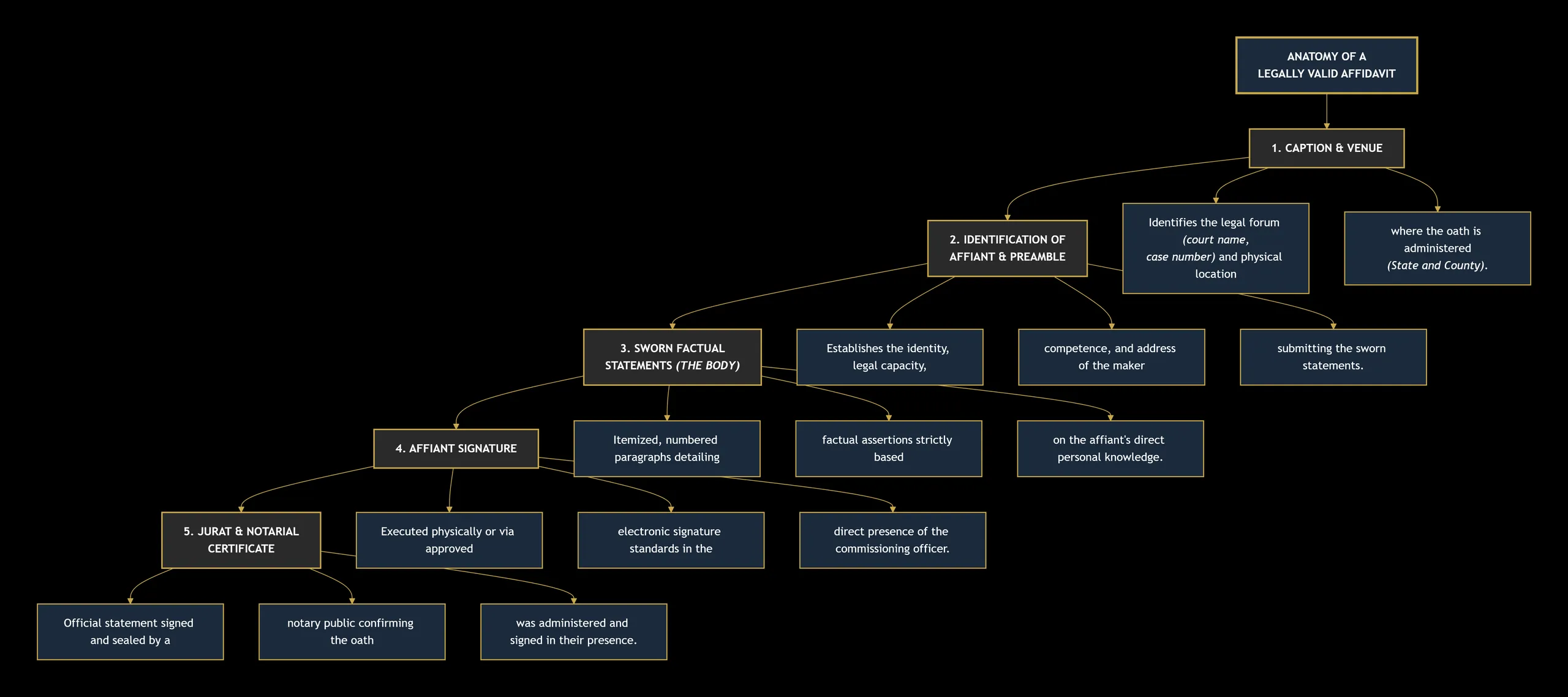
1. Caption and Statement of Venue
The opening header of an affidavit establishes its institutional and physical jurisdiction:
- The Caption: In active court proceedings, the header displays the court name, judicial district, title of the action (plaintiff versus defendant), and designated docket or case number.
- The Statement of Venue: Preceded by the legal notation “State of [State], County of [County], to wit:”, the venue states the exact physical location where the affiant appeared before the officer administering the oath.
2. Identification of the Affiant
The affiant is the individual who authors, signs, and swears to the truth of the statements contained within the affidavit. The opening preamble explicitly establishes the affiant’s identity, adult age, mental capacity, physical residence, and relationship to the underlying legal matter.
3. Sworn Statement of Personal Knowledge
The body of the affidavit consists of chronological, numbered paragraphs detailing specific facts. To preserve evidentiary integrity, the narrative must conform to strict standards:
- Personal Knowledge Standard: Statements must reflect what the affiant directly observed, heard, or executed, rather than speculative opinions, legal arguments, or second-hand gossip.
- Information and Belief Exception: When an affiant must include facts they reasonably believe to be true but did not witness firsthand, the text must explicitly state: “The affiant is informed and believes, and upon such information and belief asserts, that…”
4. The Jurat and Notarial Verification
The concluding section of an affidavit is the Jurat (derived from the Latin juratum, meaning “sworn”). The jurat is the official written clause where the notary public or judicial officer certifies that:
- The affiant physically or virtually appeared before the officer on a specified date.
- The officer verified the affiant’s identity using satisfactory government documentation.
- The officer administered an oath or solemn affirmation.
- The affiant executed the signature in the direct presence of the officer.
Comparative Analysis: Affidavits vs. Related Legal Instruments
To select the correct evidentiary document during legal proceedings, practitioners must distinguish affidavits from other common written instruments.

Affidavits versus Depositions
While both instruments provide sworn factual evidence, their procedural environments differ significantly:
- Method of Creation: An affidavit is an ex parte written document created independently by the affiant and their attorney without giving advance notice to opposing parties. A deposition consists of live oral examination conducted under oath in the presence of a court reporter.
- Opportunity for Cross-Examination: An affidavit contains only statements the affiant chooses to include, offering no immediate opportunity for opposing counsel to cross-examine. A deposition allows opposing counsel to ask probing, real-time questions to test credibility and expose contradictions.
- Evidentiary Weight at Trial: Because affidavits lack cross-examination protections, they are generally classified as hearsay if introduced at a full trial to prove the truth of the matter asserted. Depositions, by contrast, carry far greater evidentiary weight and are frequently admitted into trial records when witnesses are unavailable.
Affidavits versus Unsworn Declarations Under Penalty of Perjury
Modern civil procedure codes—such as 28 U.S.C. § 1746 in federal court practice—frequently permit the use of unsworn declarations as functional equivalents to affidavits.
- Notarial Requirement: An affidavit requires formal administration of an oath before a commissioned notary public. An unsworn declaration eliminates notary involvement, relying instead on a statutory closing statement: “I declare under penalty of perjury under the laws of the United States of America that the foregoing is true and correct. Executed on [Date].”
- Practical Convenience: Unsworn declarations streamline legal filings, particularly in emergency situations, international contexts, or high-volume litigation where securing a notary public creates administrative bottlenecks.
Affidavits versus Legal Pleadings
- Function: A legal pleading (such as a Complaint or Answer) outlines formal legal causes of action, affirmative defenses, and prayers for relief. An affidavit provides the underlying factual evidence needed to support or refute those claims.
- Authorship: Pleadings are drafted and signed by legal counsel acting as advocates. Affidavits are sworn to personally by fact witnesses under penalty of criminal prosecution.
Primary Applications of Affidavits Across Legal Sectors
Affidavits are utilized across civil, criminal, commercial, and administrative law practice to present sworn evidence efficiently.

1. Civil Litigation and Motion Practice
In civil court proceedings, affidavits serve as the primary mechanism for placing uncontested factual evidence before a judge during pre-trial motions:
- Summary Judgment Motions: Under Rule 56 of the Federal Rules of Civil Procedure and state equivalents, a party moving for summary judgment submits affidavits demonstrating that no genuine issue of material fact exists, entitling them to judgment as a matter of law.
- Emergency Injunctive Relief: When seeking a Temporary Restraining Order (TRO) or preliminary injunction, plaintiffs submit supporting affidavits detailing immediate, irreparable harm that will occur unless the court grants emergency relief.
- Affidavits of Service (Proof of Service): Process servers execute sworn affidavits confirming the exact date, time, physical location, and method used to deliver legal summons and complaints to defendants.
2. Criminal Procedure and Constitutional Safeguards
The Fourth Amendment to the United States Constitution requires that search and arrest warrants be issued only upon probable cause, supported by “Oath or affirmation.”
- Search Warrant Applications: Law enforcement officers draft detailed probable cause affidavits outlining specific facts, informant statements, surveillance observations, and physical evidence that justify searching a designated physical location or digital device.
- Arrest Warrant Affidavits: Investigators submit sworn statements detailing the facts establishing that a specific crime was committed and that probable cause connects the named suspect to the offense.
3. Estate Planning, Probate, and Family Law
- Self-Proving Will Affidavits: During will execution, testators and attesting witnesses sign a self-proving affidavit before a notary. When the testator passes away, probate courts accept this affidavit as conclusive proof of valid execution, avoiding the need to locate witnesses to testify in court.
- Small Estate Affidavits: Beneficiaries of small estates can use statutory affidavits to collect personal property, bank balances, or vehicle titles without undergoing lengthy probate administration.
- Financial Affidavits in Family Law: Divorcing spouses are legally required to submit sworn financial affidavits itemizing gross income, monthly living expenses, assets, and liabilities to determine child support and alimony awards.
4. Real Estate and Commercial Transactions
- Affidavits of Title: During real estate closings, property sellers execute affidavits confirming that there are no unrecorded liens, pending mechanic’s claims, unrecorded leases, or boundary disputes affecting the property title.
- Affidavits of Debt: Financial institutions and debt buyers submit sworn affidavits in collection lawsuits certifying account balances, default dates, and contract terms.
Rules of Evidence: Admissibility, Hearsay, and Impeachment
While affidavits provide a convenient method for presenting facts, their admissibility during formal trial proceedings is heavily restricted by rules of evidence.
The Hearsay Rule and Out-of-Court Statements
Under Federal Rule of Evidence 801, hearsay is an out-of-court statement offered in evidence to prove the truth of the matter asserted. Because an affidavit is executed outside of court without giving opposing parties an opportunity to cross-examine the affiant, it constitutes technical hearsay.
Consequently, while judges routinely consider affidavits during pre-trial motion practice, affidavits are generally inadmissible as standalone substantive evidence during full civil or criminal trials, unless a specific statutory exception applies (such as public record exceptions or witness unavailability under Rule 804).
Use of Affidavits for Witness Impeachment
If an affiant later takes the witness stand during a trial and provides oral testimony that contradicts their previously sworn affidavit, opposing counsel can introduce the affidavit under Federal Rule of Evidence 607 to impeach the witness’s credibility.
When a witness’s trial testimony directly contradicts their prior affidavit on a material fact, it undermines their truthfulness before the jury and can expose the witness to criminal perjury investigations if the contradiction was intentional.
Perjury and Criminal Liability for False Affidavits
Because an affidavit is executed under an oath administered by an authorized officer, signing an affidavit containing false statements carries severe civil and criminal consequences.
Elements of the Offense of Perjury
To convict an affiant of perjury based on a false affidavit, prosecutors must prove four legal elements beyond a reasonable doubt:
- Administration of a Valid Oath: The affiant took a formal oath or affirmation administered by a notary public or authorized judicial officer.
- Falsity of Statement: The statement contained within the affidavit was factually untrue at the time it was made.
- Willful Intent: The affiant made the false statement knowingly and intentionally, rather than as a result of honest mistake, oversight, or misunderstanding.
- Materiality: The false statement involved a material fact capable of influencing the decision-making process of the court, agency, or official reviewing the document.
The Sham Affidavit Doctrine
In civil litigation, parties sometimes attempt to submit contradictory affidavits to avoid summary judgment. Under the Sham Affidavit Doctrine, if a party submits an affidavit that directly contradicts their prior sworn deposition testimony without providing a plausible explanation for the contradiction, the court will disregard the affidavit as a sham designed solely to fabricate a fake issue of fact.
Step-by-Step Guide: Drafting an Enforceable Affidavit
Drafting an effective affidavit requires careful attention to legal phrasing, chronological structure, and strict adherence to personal knowledge standards.
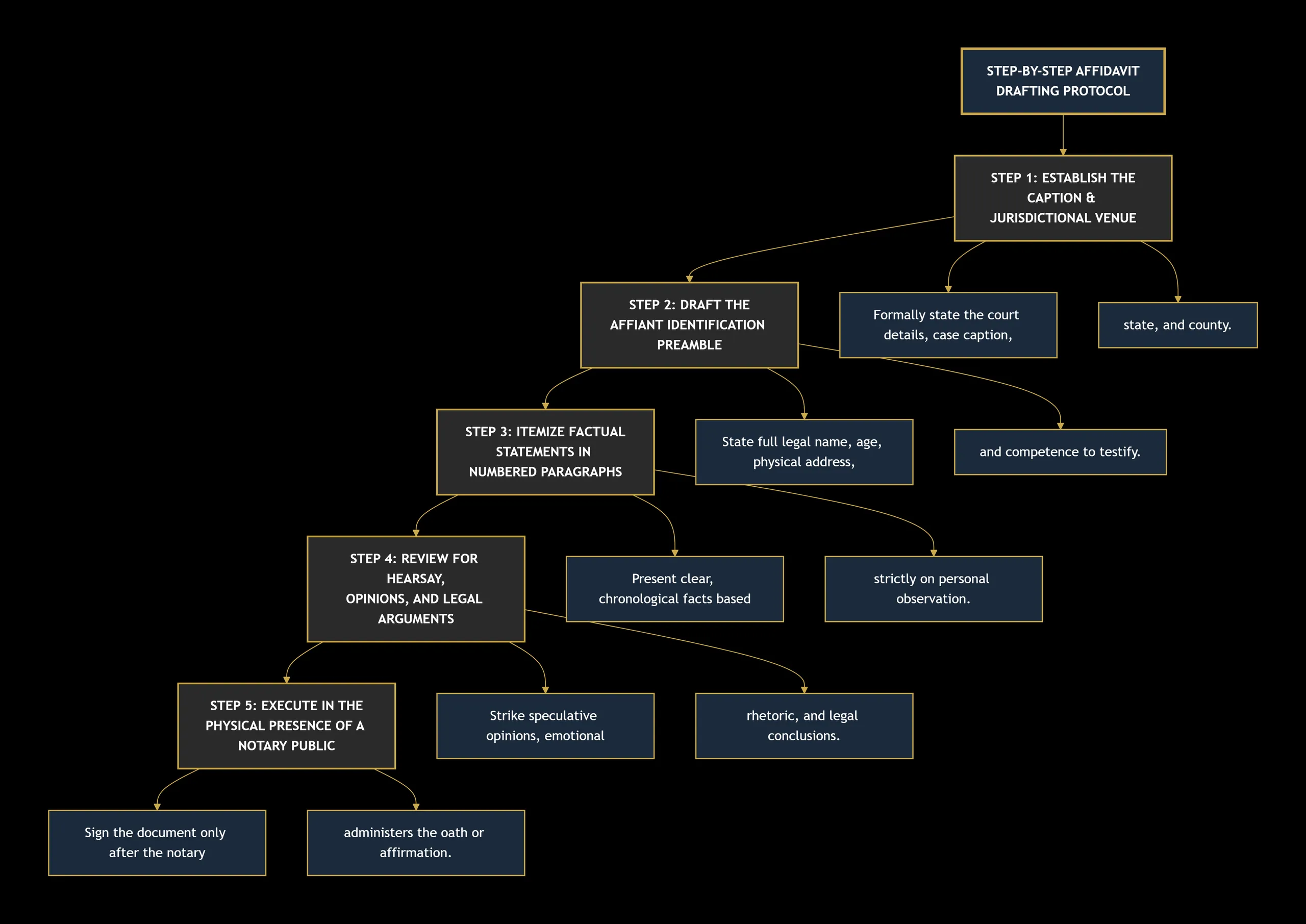
Step 1: Format the Header and Venue
Begin with a standardized court caption if the affidavit is being filed in active litigation. Below the caption, insert the state and county venue clause to establish where the notary public’s official authority is being exercised.
Step 2: Formulate the Affiant Preamble
Include a clear intro statement: “I, [Full Legal Name], being first duly sworn, depose and state as follows under penalty of perjury…” Expressly state that you are over 18 years of age and competent to testify regarding the facts set forth in the document.
Step 3: Present Chronological, Numbered Paragraphs
Organize facts logically, devoting each numbered paragraph to a single event, conversation, or transaction. Use precise dates, times, geographic locations, and participant names rather than vague generalizations.
- Incorrect Phrasing:“The defendant was driving dangerously and hit my car.”
- Correct Evidentiary Phrasing:“On October 14, 2025, at approximately 3:15 PM, I observed the defendant’s red sedan pass through a red traffic signal at the intersection of Main Street and 5th Avenue without stopping, striking the driver-side door of my vehicle.”
Step 4: Include Necessary Documentary Exhibits
If the affidavit references contracts, emails, photographs, or financial statements, label them clearly as exhibits (e.g., “A true and correct copy of the contract signed on January 10, 2026, is attached hereto as Exhibit A.”).
Step 5: Execute Before a Notary Public
Do not sign the affidavit in advance. The affiant must sign the document in the direct presence of a commissioned notary public or authorized judicial officer, after the officer explicitly asks: “Do you solemnly swear that the statements contained in this affidavit are true to the best of your knowledge, information, and belief, so help you God?” (or offers a non-religious affirmation). The notary then completes the jurat and attaches their official seal.
Frequently Asked Questions
Can an individual sign an affidavit on behalf of someone else using a Power of Attorney?
Generally, no. An affidavit represents personal sworn testimony based on the affiant’s direct individual knowledge. While an attorney-in-fact operating under a Power of Attorney can execute financial or business contracts on behalf of a principal, they cannot swear to another person’s personal knowledge or mental state.
What is the legal difference between an oath and a solemn affirmation in an affidavit?
An oath is a formal declaration invoking a divine witness or supreme deity to confirm the truth of the statement (“So help me God”). A solemn affirmation is a legally equivalent non-religious declaration made under penalty of perjury for individuals who hold religious objections to taking oaths or choose not to invoke a deity. Both carry identical legal weight and perjury penalties.
Does a notarized affidavit make the facts contained within it automatically true in court?
No. Notarization simply certifies that the identified affiant appeared before a notary, provided valid identification, and swore that the contents were true. It does not prove that the underlying assertions are factually accurate, nor does it prevent opposing parties from challenging the statements with contradictory evidence or cross-examination.
What happens if an affidavit is executed without a notary seal or complete jurat?
An affidavit missing a valid jurat, notary signature, or official seal is considered legally defective in most jurisdictions. Courts routinely strike defective affidavits from the record, refusing to consider them as competent evidence during motion practice unless cured by supplemental filings or permitted under statutory unsworn declaration rules.
Can an affidavit be used as evidence at a jury trial if the affiant is unavailable to testify?
Usually, no. Introducing an affidavit at trial when the affiant is absent violates hearsay rules and deprives opposing counsel of the right to cross-examine the witness. An affidavit can be admitted only under narrow evidentiary exceptions, such as where statutory provisions explicitly allow it or where a witness is legally unavailable and the opposing party had a prior opportunity to cross-examine them.
Affidavits remain an indispensable mechanism for converting written observations into sworn evidentiary statements across civil, criminal, and administrative practice. By adhering to structural formatting rules, maintaining strict personal knowledge standards, and executing documents before authorized commissioning officers, legal practitioners ensure their filings withstand judicial scrutiny. For comprehensive statutory definitions, procedural rules, and legal templates, review the complete analysis on The Law to Know
.
Daily Quiz
Criminal Procedure
10 questions, new every day. See how many you get right — then come back tomorrow for a new category.
Question 1 of 10
What is the "inevitable discovery" doctrine?
Inevitable discovery is a narrow exception to the exclusionary rule — if the prosecution can show the evidence would have been found anyway through an independent, lawful investigative path, it may still be admitted.
Question 2 of 10
What did Brady v. Maryland (1963) establish regarding a prosecutor's disclosure obligations?
Brady established that suppressing evidence favorable to the defense and material to guilt or punishment violates due process — a foundational disclosure obligation prosecutors must satisfy regardless of good or bad faith.
Question 3 of 10
What do "stop and identify" statutes, where they exist, generally require?
Some, but not all, states have stop-and-identify laws requiring a person who has been lawfully stopped based on reasonable suspicion to provide identifying information — these statutes vary significantly, and some states have none at all.
Question 4 of 10
What is a grand jury's role?
A grand jury doesn't decide guilt — its job is to review the prosecution's evidence and decide whether probable cause exists to issue an indictment, moving the case forward to trial.
Question 5 of 10
What is the "public safety exception" to Miranda?
This narrow exception recognizes that in a genuine, immediate public-safety emergency (like locating a hidden weapon), officers can ask limited necessary questions before Mirandizing a suspect, without automatically losing the ability to use the answers.
Question 6 of 10
At what point does a criminal defendant's Sixth Amendment right to counsel generally "attach"?
The Sixth Amendment right to counsel is tied to the start of formal criminal proceedings, not simply the commission of a crime or an initial arrest — this is a distinct question from the separate Miranda right to counsel during custodial interrogation.
Question 7 of 10
What is the general legal basis for the "border search exception"?
Routine border searches are treated differently from ordinary domestic searches — the government's sovereign interest in controlling entry generally allows more latitude to search persons and property at the border without the usual warrant or probable cause requirements.
Question 8 of 10
What is the "automobile exception" to the warrant requirement?
Courts have recognized that a vehicle's ready mobility (it could simply be driven away while police wait for a warrant) justifies a warrant exception when officers have probable cause to believe it contains evidence of a crime.
Question 9 of 10
What is the basic difference between "probation" and "parole"?
Probation generally lets a convicted person avoid prison altogether, serving their sentence under supervision in the community instead. Parole is different — it is supervised release granted to someone after they have already served part of an actual prison sentence.
Question 10 of 10
What is the "entrapment" defense?
Entrapment focuses on whether the government's own conduct created the crime — merely providing an opportunity to someone already willing to commit the offense is not entrapment, but inducing an unwilling person to do so can be.
Come back tomorrow for Constitutional Law.
Enjoyed Criminal Procedure? Go deeper:
Continue with the Criminal Procedure course → See the Law Enforcement course too →A quick trivia game for general legal knowledge — not legal advice, and not affiliated with any bar exam or licensing body.
Related in Foundations of Law
The information provided in this article ("Affidavits: What They Are and How They Work") is for general educational and informational purposes only and does not constitute formal legal advice. Reading this content does not create an attorney-client relationship. Laws vary by jurisdiction; consult a licensed attorney for specific legal matters.

Teaching? Share this with your class
Free to use in class. Students need no account for the free articles.
Advance Your Legal Analysis
Explore our interactive decision trees, litigation pipeline builders, and procedural court simulators designed specifically for law students and practitioners.
Access Interactive Tools →
0 Comments