Table of Contents
Need Official Legal Templates or Documents?
Access attorney-reviewed, fully editable Word (.docx) contracts and printable PDF guides formatted for immediate legal protection.
- ✓ Fully Editable: Includes Word (.docx) & printable PDF
- ✓ Key Clauses: IP transfer, non-solicitation, indemnification & remedies
- ✓ Practitioner Guide: Includes line-by-line filling instructions
Select the specific document below that best fits your requirements:
Employee vs. Independent Contractor: Legal Tests for Misclassification
The classification of a worker as either an employee (W-2) or an independent contractor (1099) is one of the most heavily scrutinized areas of employment and tax law. What often begins as a voluntary contract between a business and a service provider can quickly turn into a major legal liability if administrative agencies or courts determine that the worker was misclassified.

The distinction between employees and independent contractors does not depend on job titles, contractual labels, or mutual agreement. A signed agreement explicitly stating that a worker is an “independent contractor” carries little weight if the actual working relationship resembles employment. Instead, courts, tax authorities, and labor departments apply specific legal tests to evaluate the underlying economic and operational realities of the work.
Because different government bodies enforce different legal standards, a worker may qualify as an independent contractor under one federal rule while simultaneously being classified as an employee under state wage laws. Understanding these legal frameworks is essential for businesses structuring service contracts and for workers evaluating their legal rights and protections.
Comparative Matrix of Classification Standards
The matrix below compares the primary legal tests used across state and federal jurisdictions:
| Feature / Dimension | The ABC Test (State Wage Laws) | Federal Economic Reality Test (FLSA / DOL) | IRS Common Law Standard (Tax Code) |
| Primary Focus | Statutory presumption of employment; strict 3-prong threshold. | Economic dependence on the hiring entity versus independent business operation. | Right to direct and control the specific details of how work is executed. |
| Legal Presumption | Presumes Employment. The hiring entity must satisfy all 3 criteria to prove contractor status. | No Statutory Presumption. Evaluates the totality of economic circumstances or core factors. | No Fixed Presumption. Evaluates evidence across three primary control categories. |
| Flexibility | Rigid. Failing a single prong results in mandatory employee classification. | Balancing test weighing core and secondary factors. | Fact-specific analysis balancing multiple factors. |
| Primary Jurisdictions | CA, MA, NJ, IL (unemployment), CT, VT, and others. | Federal Wage & Hour regulations (FLSA, FMLA, MSPA). | Internal Revenue Code, state income tax, Federal Insurance Contributions Act (FICA). |
The ABC Test: The State-Level Strict Presumption Framework
The ABC Test is the most stringent classification standard in American labor law. Unlike common law standards that balance multiple factors, the ABC test begins with a statutory presumption that any individual performing services for a business is an employee.
To lawfully classify a worker as an independent contractor under the ABC test, the hiring company carries the burden of proving that all three of the following conditions are met:
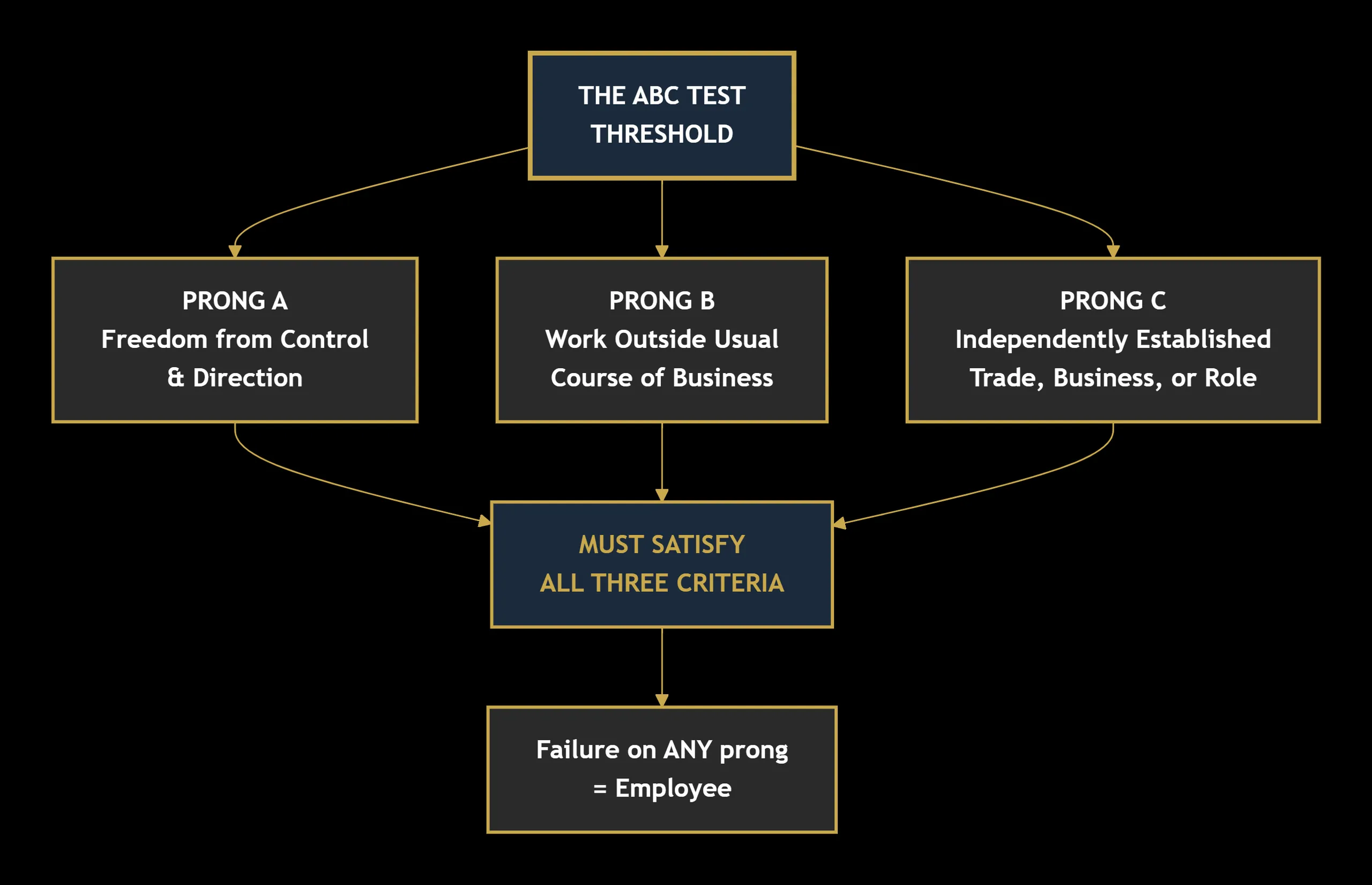
1. Prong A: Freedom from Control and Direction
The worker must be free from the control and direction of the hiring entity in connection with the performance of the work, both under the contract and in actual practice.
- Contractual Right vs. Actual Control: Even if a written contract specifies that the worker retains operational autonomy, Prong A is violated if the company manages daily routines, mandates specific step-by-step procedures, or enforces strict dress codes, schedule requirements, or mandatory administrative protocols.
- Quality Control vs. Operational Direction: While a hiring entity can inspect finished work or define final project specifications, directing how, when, and by what precise steps the work is performed triggers employee status.
2. Prong B: Work Outside the Usual Course of Business
The worker must perform work that is outside the core, usual course of the hiring entity’s business.
- The Core Business Requirement: This prong poses the highest hurdle for businesses engaging contractors. If a technology company building software hires a freelance software developer, or if a bakery hires an independent baker, the work falls directly within the company’s usual course of business. As a result, the worker fails Prong B and must be classified as an employee under the ABC test.
- Examples of Compliant Relationships: A retail clothing store hiring an independent plumber to fix a pipe, or an accounting firm hiring an outside graphic designer to redesign its corporate logo, satisfies Prong B because plumbing and graphic design fall outside the core business of those companies.
3. Prong C: Independently Established Trade or Business
The worker must be customarily engaged in an independently established trade, occupation, or business of the same nature as the work performed for the hiring entity.
- Proof of an Independent Business: To satisfy Prong C, the hiring company must show that the worker operates a distinct commercial enterprise that exists independently of the contract.
- Key Evidence of Independence:
- Active business registration (LLC, corporation, or formal sole proprietorship).
- Maintaining an independent business location, website, or marketing footprint.
- Serving multiple, non-affiliated clients simultaneously.
- Ownership of specialized tools, equipment, and professional indemnity insurance.
State Adoption & Statutory Exemptions
The ABC test was adopted by the California Supreme Court in the landmark 2018 Dynamex Operations West, Inc. v. Superior Court decision and codifying legislation (Assembly Bill 5 / AB 5 and AB 2257). Similar versions govern wage and hour disputes in Massachusetts, New Jersey, and several other states.
Recognizing the severity of Prong B, state legislatures have enacted specific statutory exemptions for professional occupations (e.g., licensed physicians, attorneys, certified public accountants, engineers, and financial advisors) and qualified business-to-business (B2B) relationships. When an exemption applies, the ABC test is waived, and courts revert to the traditional multi-factor common law test (such as California’s Borello standard).
The Federal Economic Reality Test Under the FLSA
To determine worker status under the federal Fair Labor Standards Act (FLSA)—which governs minimum wage, overtime pay, and recordkeeping—federal courts and the U.S. Department of Labor (DOL) use the Economic Reality Test.
The underlying legal question under the FLSA is whether the worker is economically dependent on the hiring enterprise for work or is genuinely in business for themselves as an independent entrepreneur.
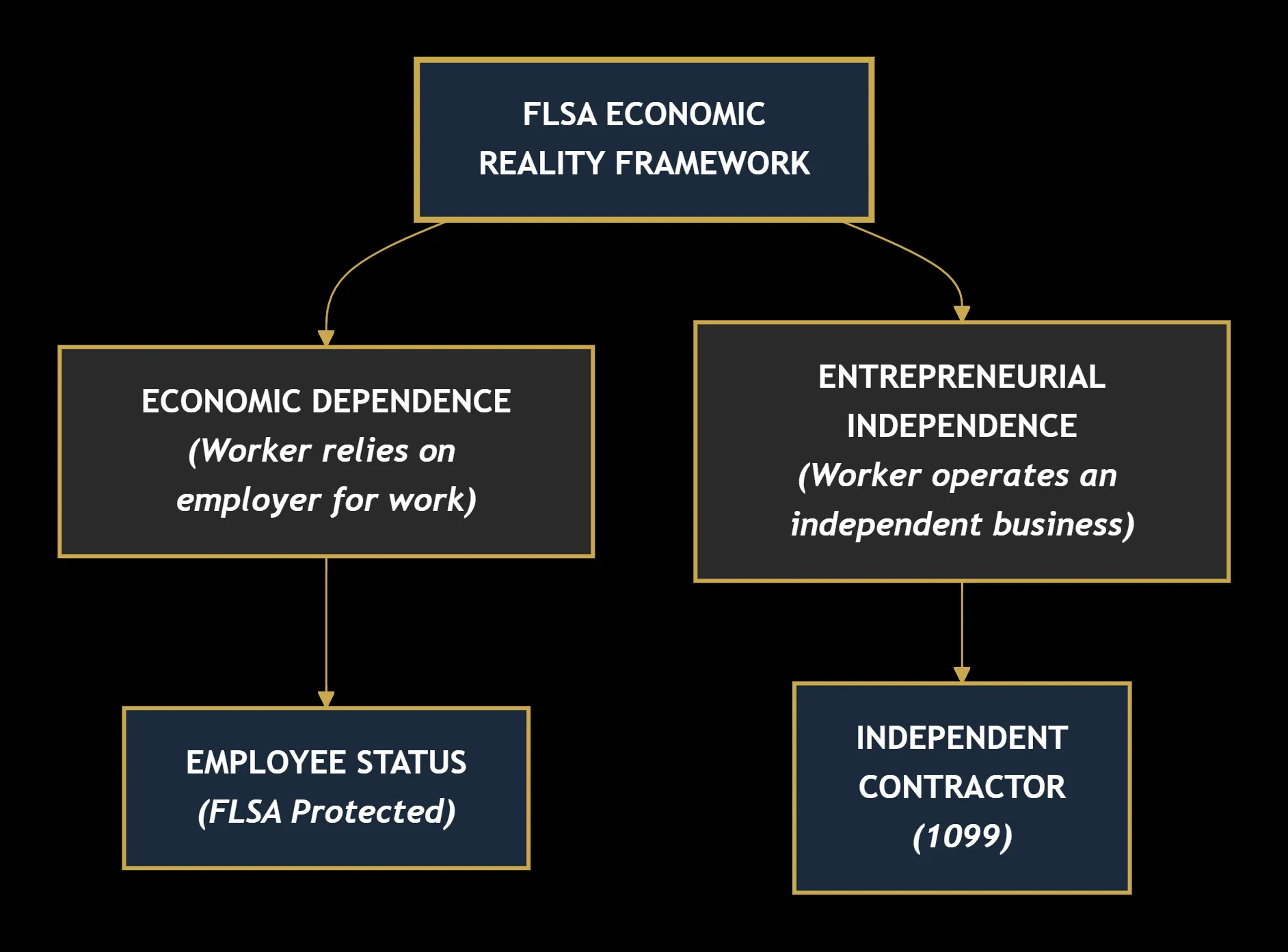
Factors in the Economic Reality Framework
The federal framework evaluates several core dimensions of the working relationship:
- Nature and Degree of Control: The extent to which the potential employer sets schedules, directly supervises performance, restricts outside work, or uses technology to monitor output.
- Opportunity for Profit or Loss Based on Initiative or Investment: Whether the worker can increase their earnings through managerial skill, cost control, strategic marketing, or business investments—as opposed to simply working more hours at a fixed rate.
- Investments by the Worker and the Employer: Comparing the worker’s capital investments in business infrastructure, specialized equipment, or tools against the hiring entity’s investments.
- Degree of Permanency of the Relationship: Continuous, indefinite, or exclusive work relationships suggest employment, whereas project-based, seasonal, or sporadic engagements point toward independent status.
- Extent to Which Work is an Integrated Unit of Production: Whether the worker’s tasks are an integral part of the business’s main operations.
- Skill and Initiative: Whether the worker relies on specialized business initiative and independent judgment, rather than performing routine tasks under supervision.
Regulatory Shifts in Federal Rulemaking
Federal worker classification rules under the FLSA have shifted across presidential administrations:
- 2021 Framework: Emphasized two “core factors”—control and profit/loss opportunity—as carrying primary weight in classification decisions.
- 2024 Rulemaking: The Biden administration issued a rule adopting a multi-factor “totality of the circumstances” test, treating all factors as equal without fixed core priorities.
- 2025–2026 Regulatory Changes: In 2025, the Department of Labor paused enforcement of the 2024 rule, and in early 2026 proposed replacing it with a streamlined framework that highlights core economic factors, bringing greater predictability to federal enforcement across the FLSA, FMLA, and related labor statutes.
The IRS Common Law Standard: The Three Control Categories
For federal tax administration, including FICA payroll taxes, income tax withholding, and FUTA unemployment taxes, the Internal Revenue Service (IRS) applies the traditional Common Law Control Test.
The IRS framework groups relevant facts into three broad control categories:

1. Behavioral Control
Behavioral control examines whether the business has the legal right to direct and control how the worker completes tasks, regardless of whether that control is actively exercised.
- Instructions: Detailed instructions covering when and where to work, which tools to use, what sequence to follow, or where to purchase supplies point toward employee status.
- Training: Providing periodic corporate training, mandating safety protocols beyond industry standards, or requiring attendance at internal operational meetings indicates that the company wants the work performed in a specific manner—a key indicator of employment.
2. Financial Control
Financial control examines whether the business controls the business and financial aspects of the worker’s daily activities.
- Unreimbursed Business Expenses: Independent contractors routinely absorb unreimbursed business overhead, licensing fees, and equipment costs.
- Significant Investment: Independent contractors usually maintain a meaningful capital investment in their own facilities, machinery, software, or specialized tools.
- Services Available to the Broader Market: An independent contractor is free to seek out business opportunities and advertise services to the general public.
- Method of Payment: Paying a fixed salary or hourly rate typically indicates an employment relationship, whereas flat fees per project, invoices based on completed milestones, or commission-only arrangements reflect independent contractor status.
3. Type of Relationship
This category examines how the parties perceive and structure their ongoing relationship.
- Written Contracts: Contracts detailing the intent of the parties provide useful documentation, though they do not override contradictory working practices.
- Employee Benefits: Providing health insurance, paid time off, disability coverage, or pension plans strongly suggests an employment relationship.
- Permanency: Engagements designed to continue indefinitely point toward employment, whereas contracts tied to defined deliverables or fixed timelines suggest independent contractor status.
IRS Form SS-8 Determinations
When a worker or hiring business is uncertain about proper tax classification, either party can submit IRS Form SS-8 (Determination of Worker Status for Purposes of Federal Employment Taxes and Income Tax Withholding). The IRS reviews the operational facts and issues an official determination. Because Form SS-8 filings heavily favor employee status, businesses should review their contractor engagements with legal counsel before filing.
The Common Law Agency Test (NLRB, ERISA, and Federal Claims)
Beyond wage laws and tax codes, federal courts apply the Common Law Agency Test when evaluating worker status under federal statutes that do not explicitly define “employee”—including the National Labor Relations Act (NLRA), the Employee Retirement Income Security Act (ERISA), and the Copyright Act (work-made-for-hire provisions).
Derived from the Restatement (Second) of Agency § 220, this test evaluates ten non-exhaustive factors to determine whether the hiring entity controls the physical details of performance:
- The extent of control the master exercises over the details of the work.
- Whether the worker is engaged in a distinct occupation or business.
- Whether the work is usually done under direction or by a specialist without supervision.
- The skill required in the particular occupation.
- Who supplies the instrumentalities, tools, and place of work.
- The length of time for which the person is employed.
- The method of payment (by time or by the job).
- Whether the work is part of the regular business of the employer.
- Whether the parties believe they are creating an agency/employment relationship.
- Whether the principal is or is not in business.
Under National Labor Relations Board (NLRB) precedent, the agency test balances these factors alongside an explicit examination of whether the worker has genuine entrepreneurial opportunity for financial gain or risk.
Financial, Regulatory, and Civil Liabilities of Misclassification
Misclassifying employees as independent contractors can create significant financial and legal liability across state and federal jurisdictions.
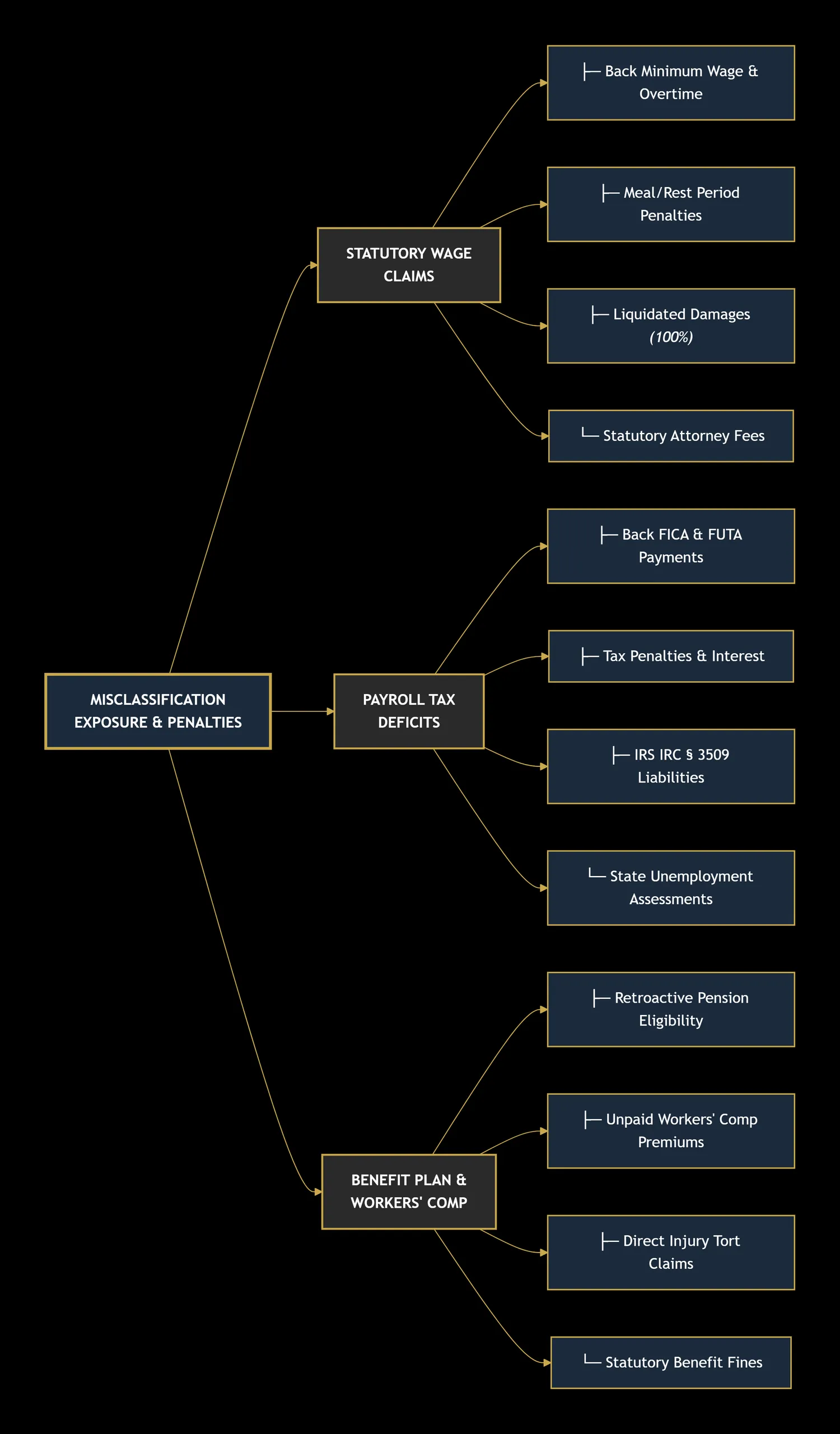
1. Wage and Hour Claims Under Federal and State Law
If a misclassified worker is ruled to be an employee, the employer becomes retroactively liable for statutory wage violations under the FLSA and state labor codes:
- Back Overtime and Minimum Wage: Paying a contractor a flat rate or hourly fee does not satisfy overtime pay requirements for hours worked over 40 per week.
- Liquidated Damages: The FLSA allows courts to award 100% liquidated damages (double back pay) for willful violations, alongside mandatory attorney fees and litigation costs.
- State Statutory Penalties: In states like California, employers face additional penalties for missing meal/rest breaks, failing to provide accurate wage statements, and late pay upon separation.
2. Tax Liabilities and IRS Penalties
Misclassification deprives federal and state governments of required payroll tax withholdings:
- FICA and FUTA Back Pay: Employers are liable for uncollected Social Security and Medicare taxes (employer and employee shares) plus federal unemployment taxes.
- Internal Revenue Code § 3509: If an employer fails to withhold employment taxes due to misclassification without a reasonable basis, IRC § 3509 assesses reduced tax penalty rates. However, if the misclassification was intentional, full back taxes, steep failure-to-file penalties, and statutory interest apply.
3. Employee Benefit Plans and Workers’ Compensation
- Retroactive Benefit Claims: Under ERISA, misclassified workers may demand retroactive coverage under company health plans, 401(k) matches, and stock option programs.
- Workers’ Compensation Violations: Operating without required workers’ compensation coverage for misclassified contractors leaves companies exposed to administrative fines, mandatory stop-work orders, and direct civil liability if a worker suffers an on-the-job injury.
Statutory Safe Harbors and Mitigation Strategies
Businesses facing classification audits or seeking to correct historical misclassification can evaluate specific statutory safe harbor protections.
1. Section 530 Safe Harbor under the Revenue Act of 1978
Section 530 provides a federal safe harbor that relieves employers of federal employment tax liabilities if three strict statutory requirements are met:
- Consistent Reporting: The business filed all required federal tax returns (including Form 1099-NEC) consistent with treating the worker as an independent contractor.
- Substantive Consistency: The business did not treat any worker holding a substantially similar position as an employee for employment tax purposes after 1977.
- Reasonable Basis: The company relied on a reasonable legal basis for treating the worker as a contractor, such as:
- Judicial precedent or published IRS rulings.
- A past IRS audit that cleared similar contractor classifications.
- A long-standing, recognized practice within the industry.
2. The IRS Voluntary Classification Settlement Program (VCSP)
The VCSP allows eligible businesses to voluntarily reclassify independent contractors as employees for future tax periods in exchange for partial tax relief:
- Participants pay approximately 1% of the wages paid to reclassified workers for the most recent tax year.
- The IRS waives interest, penalties, and back employment tax audits for prior tax years.
- Eligibility: The business must have consistently issued 1099s to the workers for the prior three years, maintained a clean employment tax audit record, and not currently be under audit by the IRS or DOL.
Operational Compliance Checklist for Managing 1099 Relationships
To manage independent contractor relationships effectively and mitigate misclassification risk, businesses should establish clear operational boundaries:
- [ ] Incorporate as a Formal Business Entity: Require contractors to operate through a registered LLC, S-Corporation, or formal sole proprietorship.
- [ ] Verify Multi-Client Footprint: Ensure the contractor advertises their services publicly, serves multiple non-affiliated clients, and maintains a distinct business website.
- [ ] Avoid Integration into Core Operations: Confirm that the requested services fall outside the company’s primary product or service offerings (to satisfy the ABC Test).
- [ ] Require Independent Equipment and Infrastructure: Confirm that contractors bring their own laptop, software licenses, tools, and professional equipment.
- [ ] Structure Payments on Output or Project Milestones: Avoid paying fixed hourly wages; tie compensation directly to defined project deliverables or flat-fee milestones.
- [ ] Eliminate Internal Employment Protocols: Do not issue company email addresses with employee badges, invite contractors to internal performance reviews, require attendance at staff meetings, or provide employee handbook policies.
- [ ] Maintain Annual Proof of Insurance: Require contractors to provide current certificates of general liability and professional indemnity insurance coverage.

Daily Quiz
Constitutional Law
10 questions, new every day. See how many you get right — then come back tomorrow for a new category.
Question 1 of 10
What is judicial review of executive action generally used for?
Just as courts can review whether legislation is constitutional, they can also review whether executive branch action — an agency regulation, an executive order — exceeds legal authority or violates constitutional limits.
Question 2 of 10
What is the "state action doctrine"?
With narrow exceptions, most constitutional rights limit what government can do, not what private parties can do to each other — a private business generally is not bound by the Constitution's equal protection or free speech guarantees the way government is.
Question 3 of 10
What is "sovereign immunity," broadly speaking?
Sovereign immunity traces back to old common-law principles, but it is not absolute in modern practice — governments at both the federal and state level have waived it, by statute or otherwise, for many categories of claims.
Question 4 of 10
What does the Commerce Clause generally allow Congress to do?
The Commerce Clause is one of Congress's broadest sources of power — though the Supreme Court has, at various points, drawn real limits on how far "affecting interstate commerce" can stretch.
Question 5 of 10
How can the U.S. Constitution be amended?
Amending the Constitution is deliberately difficult — Article V requires a supermajority to propose an amendment and ratification by the vast majority of states, making it far harder than passing an ordinary law.
Question 6 of 10
What role does the Senate play in the federal treaty-making process?
Treaty-making is a shared power — while the President negotiates treaties, the Constitution requires Senate "advice and consent," including a two-thirds vote, before a treaty can be ratified, a significant structural check on executive foreign-policy power.
Question 7 of 10
What is congressional "oversight power"?
Congressional oversight — investigations, hearings, and information requests directed at the executive branch — is a key structural tool for checking how faithfully and effectively laws Congress passed are actually being carried out.
Question 8 of 10
What is meant by the "Bill of Rights"?
The Bill of Rights (the first ten amendments, ratified in 1791) was added to address concerns that the original Constitution did not sufficiently protect individual liberties against the newly created federal government.
Question 9 of 10
What are the three branches of the U.S. federal government, and what principle keeps their powers separate?
Separation of powers divides government into three branches — Legislative (Congress, which makes laws), Executive (which enforces them), and Judicial (which interprets them) — each with checks on the others.
Question 10 of 10
What is the constitutional "right to travel"?
Though not spelled out explicitly in the constitutional text, the Supreme Court has long recognized a fundamental right to travel between states, generally limiting a state's ability to penalize new residents simply for having recently arrived from elsewhere.
Come back tomorrow for Tort Law.
Enjoyed Constitutional Law? Go deeper:
Continue with the Constitutional Law course →A quick trivia game for general legal knowledge — not legal advice, and not affiliated with any bar exam or licensing body.
Related in Labor Law
The information provided in this article ("Employee vs. Independent Contractor: Legal Tests for Worker Misclassification") is for general educational and informational purposes only and does not constitute formal legal advice. Reading this content does not create an attorney-client relationship. Laws vary by jurisdiction; consult a licensed attorney for specific legal matters.

Teaching? Share this with your class
Free to use in class. Students need no account for the free articles.
Advance Your Legal Analysis
Explore our interactive decision trees, litigation pipeline builders, and procedural court simulators designed specifically for law students and practitioners.
Access Interactive Tools →
0 Comments