Legal Reasoning and Judicial Interpretation: How Courts Apply the Law
Need Official Legal Templates or Documents?
Access attorney-reviewed, fully editable Word (.docx) contracts and printable PDF guides formatted for immediate legal protection.
- ✓ Fully Editable: Includes Word (.docx) & printable PDF
- ✓ Key Clauses: IP transfer, non-solicitation, indemnification & remedies
- ✓ Practitioner Guide: Includes line-by-line filling instructions
Select the specific document below that best fits your requirements:
Table of Contents

How Do Courts Apply the Law?
Courts apply the law by identifying the relevant legal rules, interpreting their meaning, determining which facts have been legally established, and applying the rules to those facts to reach a reasoned decision. This process is called legal reasoning. Where the meaning of a legal text is disputed, courts engage in legal interpretation to determine what the Constitution, statute, regulation, contract, or other legal authority requires.
In simple terms, a court must answer three fundamental questions:
What is the law?
What happened?
How does the law apply to what happened?
The process sounds straightforward, but difficult cases rarely are. Legal texts may be ambiguous. Precedents may point in different directions. Facts may be disputed. Different legal principles may conflict. Constitutional values may limit governmental power. And apparently similar cases may have legally significant differences.
Courts therefore do more than mechanically “look up the answer.”
They construct a legally justified argument from recognized sources of law.
Legal reasoning is consequently one of the central skills of the legal profession. It explains how courts transform abstract rules into decisions about concrete disputes—and how individual cases can, in turn, contribute to the development of law.
What Is Legal Reasoning?
Legal reasoning is the structured process of using legal rules, principles, authorities, and established facts to reach a legally justified conclusion.
A simplified model is:
Legal rule + legally established facts → legal conclusion
For example:
A law establishes that a person who negligently causes legally recognized harm to another may be liable for damages.
A court determines that:
- the defendant owed the relevant duty;
- the defendant acted negligently;
- the conduct caused the relevant harm;
- and the claimant suffered legally compensable damage.
The court can then apply the legal rule to those facts and determine liability.
This is often described as applying the law to the facts.
But the difficult part is usually determining what the rule means and whether the facts actually satisfy its requirements.
The Basic Structure of a Judicial Decision
Many legal decisions can be understood through a basic structure:
1. Facts
What happened?
2. Issue
What legal question must the court decide?
3. Rule
What law governs the question?
4. Application
How does the law apply to the established facts?
5. Conclusion
What result follows?
This structure is often associated with the IRAC method:
Issue → Rule → Application → Conclusion
IRAC is particularly useful for law students because it teaches them to separate the legal question from the governing rule and from the factual analysis.
Real judicial reasoning is often considerably more complicated, but the basic structure remains useful.
Facts Are Not the Same as Legal Facts
A court does not simply accept everything that each party says happened.
In contested litigation, facts may be disputed.
One witness may say an event occurred.
Another may deny it.
Documents may contradict testimony.
Physical evidence may support one account rather than another.
The court must therefore determine which facts have been legally established.
This produces an important distinction:
The story of what happened is not necessarily the same thing as the legally established facts.
Legal reasoning begins only after the court has determined, according to the applicable rules of procedure and evidence, what factual propositions can properly be relied upon.
Questions of Fact and Questions of Law
Legal disputes often contain both questions of fact and questions of law.
Question of fact
What actually happened?
For example:
Did the defendant see the warning sign?
Question of law
What legal rule applies?
For example:
Does the applicable statute require a warning in these circumstances?
There can also be mixed questions of law and fact.
For example:
Did the defendant’s conduct constitute negligence under the applicable legal standard?
That question requires a legal standard to be applied to factual circumstances.
Why the Distinction Matters
The distinction between law and fact affects:
- who decides the issue;
- what evidence is relevant;
- the role of a jury;
- the standard of appellate review;
- and the degree of deference given to a lower court.
In jury trials, juries may determine many factual questions while judges determine questions of law.
In other cases, judges determine both.
The precise allocation depends on the jurisdiction and procedural context.
What Is Judicial Interpretation?
Judicial interpretation is the process by which courts determine the meaning and legal effect of authoritative legal texts and principles.
Courts interpret:
- constitutions;
- statutes;
- regulations;
- treaties;
- contracts;
- and sometimes earlier judicial decisions.
Interpretation becomes particularly important when legal language is:
- ambiguous;
- general;
- incomplete;
- technically complex;
- internally inconsistent;
- or disputed by the parties.
Why Can’t Courts Simply Read the Words?
Because language is not mathematics.
Words can have several meanings.
Consider the word “reasonable.”
What does it mean?
The answer may depend upon:
- the context;
- the subject matter;
- the purpose of the rule;
- established legal doctrine;
- previous decisions;
- and the circumstances of the dispute.
Similarly, a statute may prohibit conduct involving a particular category of “vehicle.”
Whether that term includes a new form of transportation may not be obvious from the dictionary alone.
Interpretation is therefore unavoidable.
Theories of Legal Interpretation
Different legal systems and judges have developed different approaches to interpretation.
Among the most important are:
- textualism;
- purposivism;
- intentionalism;
- structural interpretation;
- precedent-based interpretation;
- constitutional interpretation;
- and, in some contexts, historical approaches.
These approaches do not always produce the same result.
The disagreement between them reflects a deeper philosophical question:
When a legal text is uncertain, what should determine its meaning?
Textualism
Textualism emphasizes the ordinary or legally established meaning of the statutory text.
The basic idea is that courts should interpret the words enacted by the legislature rather than substitute their own policy preferences.
A textualist judge may ask:
- What does the statutory language say?
- What would the relevant words ordinarily have meant in context?
- How are those words used elsewhere in the statute?
- What legal terms of art are involved?
- What grammatical structure does the provision have?
Textualism therefore places substantial weight on the enacted text.
The Ordinary Meaning of Words
Courts often begin with the language itself.
Suppose a statute states:
“No person may enter the building after midnight.”
A court may initially ask what “enter,” “building,” and “after midnight” ordinarily mean.
But even simple language can become complicated.
Does entering include:
- putting one foot through the doorway?
- remaining inside after midnight?
- entering through a window?
- entering electronically through a restricted digital system?
Context matters.
Contextual Interpretation
Words do not exist in isolation.
A statutory provision should generally be read as part of the larger legal text.
Courts may consider:
- surrounding provisions;
- definitions;
- related sections;
- statutory structure;
- exceptions;
- cross-references;
- and the relationship between different provisions.
A definition contained elsewhere in the statute may completely change the apparent meaning of a word.
Canons of Construction
Courts have developed numerous canons of construction—traditional principles used to interpret legal texts.
Examples include principles concerning:
- the whole-text rule;
- specific provisions versus general provisions;
- consistent usage;
- avoiding surplusage;
- expressio unius;
- ejusdem generis;
- and noscitur a sociis.
These doctrines can help courts resolve uncertainty.
They are not magic formulas, however.
Their use and weight can vary by jurisdiction and context.
Ejusdem Generis
The Latin expression ejusdem generis means roughly “of the same kind.”
It can apply where general words follow a list of specific examples.
For example:
“Cars, trucks, motorcycles, and other vehicles.”
A court might consider whether “other vehicles” refers to things of a similar kind to the listed transportation devices.
The canon can help prevent an extremely broad interpretation of general language.
Expressio Unius
Expressio unius est exclusio alterius is traditionally understood as meaning that the expression of one thing may imply the exclusion of others.
For example, if a statute expressly identifies three categories and provides a benefit only to those categories, a court may consider whether the omission of other categories was intentional.
But the principle is not automatic.
The context may demonstrate that the legislature did not intend exclusion.
Noscitur a Sociis
Noscitur a sociis means that a word may be understood by the company it keeps.
In other words, surrounding words can help determine meaning.
A word with several possible meanings may take on a more specific meaning because of the words surrounding it.
This illustrates a broader principle:
Legal meaning is often contextual rather than purely dictionary-based.
The Whole-Text Principle
Courts generally attempt to read legislation as a coherent whole.
A provision should not ordinarily be interpreted in isolation if doing so creates an unnecessary conflict with another part of the statute.
Judges may therefore ask:
- How does this provision fit into the statute?
- Does this interpretation make another provision meaningless?
- Does it create an internal contradiction?
- Does another section provide a definition?
- Is there a specific exception?
This approach reflects the idea that legislation should be interpreted systematically.
Purposive Interpretation
Purposive interpretation asks what purpose the legislation was intended to achieve.
A purposive court may consider:
- the problem the legislation addresses;
- the policy reflected in the statutory structure;
- the mischief the statute was designed to remedy;
- and the consequences of competing interpretations.
The underlying idea is that legal language should be interpreted in a way that advances the statute’s legitimate purpose.
Text Versus Purpose
Textualism and purposivism are sometimes presented as complete opposites.
In practice, the relationship is more complicated.
A court may begin with statutory text while also considering context and purpose.
Even textual interpretation can involve judgments about:
- context;
- grammar;
- legal terminology;
- statutory structure;
- and historical meaning.
Likewise, purposive interpretation remains constrained by the text.
A court generally cannot simply invoke “purpose” to rewrite legislation.
Legislative Intent
Another interpretive approach focuses on legislative intent.
The question becomes:
What did the lawmakers intend the legislation to accomplish?
Determining collective legislative intent is difficult.
A legislature consists of many individuals who may have supported a bill for different reasons.
One legislator’s statement does not necessarily establish the intention of the entire legislative body.
This is one reason courts have developed different views about the use of legislative history.
Legislative History
Legislative history may include:
- committee reports;
- legislative debates;
- amendments;
- hearing materials;
- explanatory documents;
- and statements by legislators.
Some judges consider such materials useful in interpreting ambiguous legislation.
Others give them limited weight, particularly when the statutory text itself is sufficiently clear.
The role of legislative history varies significantly according to jurisdiction and interpretive philosophy.
Constitutional Interpretation
Constitutions create an additional interpretive problem.
Unlike ordinary statutes, constitutions often contain broad concepts such as:
- liberty;
- equality;
- due process;
- freedom of speech;
- unreasonable searches;
- and separation of powers.
These concepts cannot always be reduced to precise technical instructions.
Courts therefore use different approaches to constitutional interpretation.
Original Meaning
An originalist approach generally asks about the meaning of constitutional text at the relevant historical period.
Different forms of originalism may focus on:
- original public meaning;
- historical understanding;
- or constitutional practice.
Originalism is particularly important in American constitutional law.
Its proponents argue that constitutional meaning should not simply change according to judicial preferences.
Its critics raise questions about historical disagreement, constitutional development, and the application of old principles to new circumstances.
Living Constitutionalism
A contrasting approach is often called living constitutionalism.
It emphasizes the idea that constitutional principles may be applied in light of contemporary circumstances.
Under this approach, the meaning or application of broad constitutional principles can develop as society changes.
The disagreement between originalism and living constitutionalism illustrates a profound question:
Should constitutional law primarily preserve historical meaning, or should constitutional principles evolve as circumstances change?
There is no simple answer accepted by all judges or scholars.
Precedent as a Method of Reasoning
Courts do not interpret every legal question from scratch.
They rely heavily on precedent.
When a higher court has already interpreted a statute or constitutional provision, lower courts may be bound by that interpretation.
The doctrine of stare decisis therefore influences legal reasoning.
A judge asks not only:
“What does this legal text mean?”
but also:
“How have authoritative courts previously understood it?”
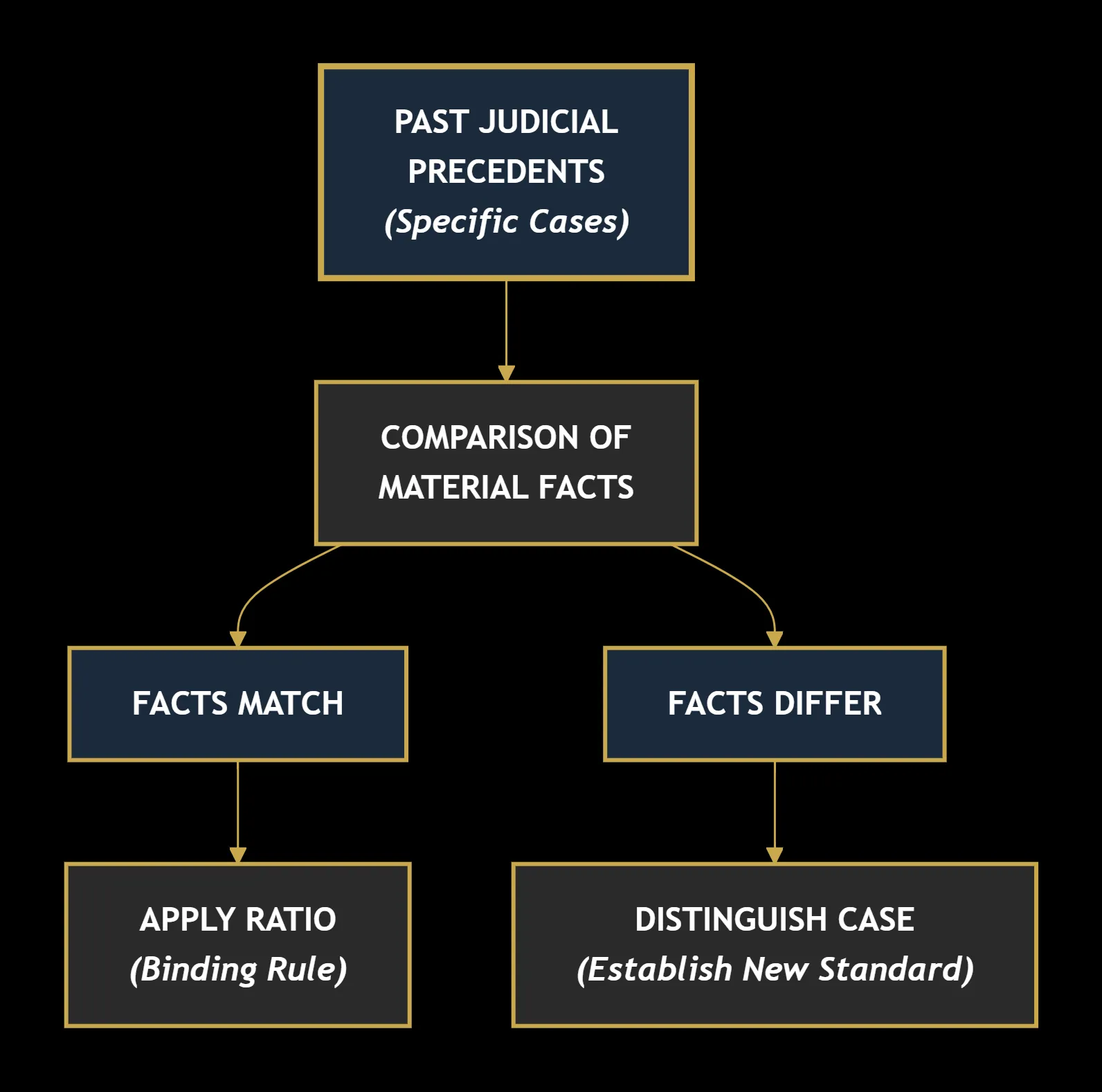
Distinguishing Cases
Not every apparently similar case must produce the same result.
Courts may distinguish an earlier case by identifying a legally significant factual or legal difference.
For example:
Case A:
A customer slips on a wet floor that the store knew was dangerous.
Case B:
A customer slips on a wet floor that became wet seconds earlier and the store had no reasonable opportunity to discover it.
The cases may look similar.
But the difference in knowledge and opportunity to respond may matter legally.
Distinguishing cases allows precedent to remain stable while accommodating factual variation.
Overruling Precedent
A higher court may sometimes overrule an earlier precedent.
This is a significant judicial act.
Courts may reconsider precedent because:
- the earlier rule is unworkable;
- it has produced serious inconsistency;
- its reasoning is fundamentally flawed;
- later developments have undermined it;
- or exceptional circumstances justify change.
Because precedent promotes stability, overruling is normally treated as a serious matter rather than an ordinary judicial preference.
Analogical Reasoning
Lawyers and judges frequently reason by analogy.
They compare the present case with previous cases and ask whether the underlying legal principle should apply.
Suppose an earlier case establishes that a manufacturer may be liable where it creates a foreseeable risk to consumers.
A later dispute concerns a new technology.
The technology did not exist when the earlier case was decided.
The court may ask:
Is the new technology sufficiently analogous to the earlier situation that the same principle should apply?
Analogical reasoning allows law to adapt without requiring a completely new rule for every technological development.
Deductive Legal Reasoning
Legal reasoning can also take a deductive form.
The classic structure is:
Major premise: A valid legal rule applies to category X.
Minor premise: The defendant’s conduct falls within category X.
Conclusion: The legal consequence prescribed by the rule follows.
For example:
Rule: A person who intentionally takes another person’s property without permission may commit theft under the applicable statute.
Fact: The defendant intentionally took another person’s property without permission.
Conclusion: The statutory elements of the offense may be satisfied.
This looks like formal logic.
But the difficult legal questions often arise in establishing whether the rule applies and whether the facts satisfy each element.
The Problem of Classification
A large part of legal reasoning involves classification.
The law establishes categories.
The court must determine whether the facts belong to one of them.
For example:
Is something:
- property?
- a contract?
- negligence?
- a publication?
- a search?
- a vehicle?
- a public forum?
- a trade secret?
Classification determines which legal rules apply.
This is why legal disputes can sometimes turn on the precise characterization of a fact.
Rules and Standards
Legal systems contain both rules and standards.
A rule may say:
“A claim must be filed within two years.”
A standard may say:
“A person must act reasonably.”
Rules provide relatively specific instructions.
Standards require judgment about circumstances.
Standards give courts flexibility but also increase uncertainty.
Rules promote predictability but can sometimes produce harsh results when applied mechanically.
Legal systems constantly balance these competing qualities.
Legal Principles
Courts also reason from broader legal principles.
Examples include:
- fairness;
- equality;
- proportionality;
- good faith;
- legal certainty;
- due process;
- protection against arbitrary government action;
- and respect for precedent.
Principles may not function like precise rules.
Instead, they can guide interpretation when several legal outcomes are possible.
The Philosophical Foundations of Legal Reasoning
Legal reasoning has been debated by philosophers for centuries.
One important tradition is natural law.
Natural-law thinkers argue, in different forms, that law is connected to principles of justice, morality, or reason.
For Aristotle, law and justice were closely connected to the ordering of the political community.
For Thomas Aquinas, human law was connected to reason and the common good.
Later thinkers developed different versions of natural-law theory.
Legal Positivism
Legal positivism takes a different approach.
Legal positivists generally distinguish the question:
“What is the law?”
from:
“Is the law morally good?”
Thinkers such as H. L. A. Hart emphasized the role of social rules and institutional recognition in identifying valid law.
This perspective helps explain why legal reasoning often focuses on recognized legal sources rather than simply asking what result would be morally desirable.
Dworkin and Law as Integrity
Ronald Dworkin challenged aspects of legal positivism.
He argued that legal reasoning involves not only rules but also principles.
Judges, in his account, should interpret the law in a way that gives the legal system the best coherent justification consistent with its institutional history.
His concept of law as integrity presents adjudication as an interpretive practice rather than a mechanical application of pre-existing rules.
Legal Realism
American legal realists emphasized another dimension.
They questioned the idea that judicial decisions can always be derived mechanically from legal rules.
Realists highlighted the importance of:
- facts;
- institutional context;
- judicial judgment;
- practical consequences;
- and social realities.
Their work helped produce a more realistic understanding of adjudication.
A legal rule may appear clear in theory while its application to real human circumstances remains difficult.
The Limits of Pure Logic
Legal reasoning is logical, but it is not reducible to formal logic.
The difficult questions are often:
- Which rule applies?
- What does the rule mean?
- Which precedent controls?
- Are two cases genuinely similar?
- Which facts are legally relevant?
- How should competing principles be balanced?
These questions involve interpretation and judgment.
The legal system attempts to discipline that judgment through:
- authoritative sources;
- procedural rules;
- precedent;
- standards of review;
- professional reasoning;
- and written judicial opinions.
Judicial Opinions
A judicial opinion explains why a court reached its decision.
A well-reasoned opinion usually identifies:
- the relevant facts;
- the legal issue;
- applicable authorities;
- competing arguments;
- the court’s reasoning;
- and the result.
Judicial opinions serve several functions.
They:
- resolve the dispute;
- explain the decision to the parties;
- provide guidance to lower courts;
- establish or clarify precedent;
- constrain arbitrary decision-making;
- and make judicial power more transparent.
Why Judges Explain Their Decisions
The requirement of reasoned decisions is closely connected to the rule of law.
If judges simply announced:
“The claimant wins.”
without explaining why, it would be difficult to determine whether the decision followed law or personal preference.
Reason-giving allows others to examine the decision.
Lawyers can challenge the reasoning.
Higher courts can review it.
Future courts can determine whether the reasoning should become precedent.
Academic scholars can analyze it.
The requirement to give reasons therefore disciplines judicial power.
Standards of Review
Appellate courts do not necessarily reconsider every aspect of a lower court’s decision from scratch.
Different issues may receive different standards of review.
For example, an appellate court may review a legal question de novo, meaning without deference to the lower court’s legal conclusion.
Factual findings may receive greater deference because the trial court directly observed the evidence and witnesses.
The applicable standard of review is therefore itself an important part of legal reasoning.
Burdens of Proof
Legal reasoning also depends upon the applicable burden of proof.
In a civil case, the standard is commonly the preponderance of the evidence in the United States.
In criminal cases, the prosecution generally must prove guilt beyond a reasonable doubt.
These standards influence how courts evaluate competing factual propositions.
The question is not simply:
“What probably happened?”
It is:
“Has the required level of proof been satisfied?”
Evidence and Legal Reasoning
Not all information presented to a court is necessarily admissible or equally persuasive.
Rules of evidence regulate what may be introduced and how it may be used.
Courts therefore reason from the evidentiary record permitted by applicable procedural law.
This is another reason why legal reasoning cannot be separated from procedure.
The law determines both:
what rules apply
and
what information the court may properly consider when applying them.
Statutory Interpretation in Practice
Consider a hypothetical statute:
“A person who knowingly enters a restricted government facility without authorization commits an offense.”
A court may need to determine:
What does “knowingly” mean?
Must the person know the facility is restricted?
What is a “government facility”?
Does the term include leased private buildings?
What counts as “enters”?
Does partial physical entry suffice?
What is “authorization”?
Must authorization be written?
These questions demonstrate why statutory interpretation is necessary even when legislation appears relatively simple.
Constitutional Avoidance
In some circumstances, courts apply the principle of constitutional avoidance.
Where a statute can reasonably be interpreted in two ways, one of which would create a serious constitutional problem and another that would avoid it, a court may prefer the constitutionally permissible interpretation, depending on the jurisdiction and applicable doctrine.
This principle reflects the hierarchical relationship between statutes and constitutions.
The Constitution is superior law.
Courts therefore interpret ordinary legislation within constitutional boundaries.
Separation of Powers and Interpretation
Judicial interpretation also raises a question of institutional authority.
How far may judges go when interpreting legislation?
If judges interpret statutory language too narrowly, they may fail to implement the legislature’s law.
If they interpret it too broadly, they may effectively create new law.
This tension is particularly important in constitutional democracies.
Judicial interpretation therefore exists within a broader institutional structure involving:
- legislatures;
- executives;
- administrative agencies;
- and courts.
The Judicial Role: Applying Rather Than Replacing the Law
A court’s fundamental responsibility is to decide the case according to applicable law.
That does not mean judges are incapable of developing law.
In common-law systems, judicial development is an established feature of the legal system.
But judicial development is constrained.
A court must distinguish between:
interpreting an existing legal rule
and
replacing that rule with a preferred policy.
That boundary is sometimes contested, especially in difficult constitutional and statutory cases.
Legal Reasoning as Argument
Lawyers do not simply announce conclusions.
They construct arguments.
A legal argument typically has the form:
Authority + interpretation + facts + reasoning = conclusion
A lawyer may argue:
- The statute contains a particular requirement.
- Binding precedent interprets that requirement in a particular way.
- The established facts satisfy the precedent’s relevant conditions.
- Therefore, the same legal consequence should follow.
The opposing lawyer may respond:
- The statute has a different meaning.
- The precedent is distinguishable.
- The facts are materially different.
- Another legal principle controls.
- Therefore, the opposite conclusion should follow.
The court evaluates these competing arguments.
Why Legal Arguments Can Both Be Reasonable
Legal disputes are not always disagreements between a correct argument and an obviously irrational one.
Two lawyers may:
- agree on the text;
- agree on the facts;
- agree on the precedent;
and nevertheless disagree about the result.
Why?
Because legal reasoning may involve choices about:
- interpretation;
- analogy;
- precedent;
- competing principles;
- statutory purpose;
- constitutional values;
- and the significance of factual distinctions.
This is one reason legal reasoning requires intellectual discipline rather than simple memorization.
The Role of Consequences
Courts sometimes consider the practical consequences of competing interpretations.
For example, an interpretation might:
- make another statutory provision meaningless;
- create an impossible administrative burden;
- produce absurd results;
- undermine an established legal framework;
- or generate serious constitutional concerns.
Consequences therefore can matter.
But their legal relevance depends on the jurisdiction, doctrine, and interpretive methodology involved.
A judge cannot ordinarily reject clear statutory language simply because the judge dislikes its consequences.
The Absurdity Principle
Courts sometimes avoid interpretations that would produce an absurd result.
The underlying idea is that legislation should not ordinarily be interpreted in a way that produces an outcome so irrational or unreasonable that it cannot plausibly reflect the enacted law.
This principle must be used carefully.
Courts are not generally free to label an inconvenient legislative result “absurd” merely because they disagree with it.
Legal Interpretation Is a Structured Practice
Legal reasoning may involve judgment, but it is not arbitrary.
A judge does not normally begin with:
“What result do I personally want?”
and then search for a legal justification.
The legal system imposes constraints.
Judges work within:
- constitutional provisions;
- statutes;
- regulations;
- precedent;
- procedural rules;
- evidence;
- jurisdiction;
- interpretive principles;
- and professional norms.
The stronger the legal constraint, the narrower the range of legitimate judicial outcomes.
From Rule to Judgment
The complete process can be summarized as follows:
1. Identify the dispute
↓
2. Establish the relevant facts
↓
3. Identify the legal issues
↓
4. Locate authoritative legal sources
↓
5. Interpret the relevant rules
↓
6. Examine precedent
↓
7. Apply the rules to the established facts
↓
8. Consider competing arguments
↓
9. Resolve conflicts between applicable rules or principles
↓
10. Reach and explain the legal conclusion
This is the practical architecture of adjudication.
How Lawyers Read Judicial Decisions
To understand a judicial decision, a reader should ask:
What happened?
Identify the legally relevant facts.
What was the issue?
Find the precise legal question.
What law governed?
Identify statutes, constitutional provisions, regulations, and precedent.
What did the court decide?
Identify the judgment or holding.
Why?
Analyze the reasoning.
What principle follows?
Determine the precedential significance.
What facts distinguish the case?
Identify the boundaries of the decision.
This method is far more useful than simply reading the final paragraph.
How Students Can Improve Legal Reasoning
Legal reasoning is a skill that improves through practice.
A useful method is to take a case and write:
Facts: What happened?
Issue: What legal question had to be answered?
Rule: What legal authority governed?
Reasoning: Why did the court interpret the rule that way?
Application: How did the rule fit the facts?
Holding: What did the court decide?
Precedent: What principle may apply to future cases?
Counterargument: What was the strongest argument on the other side?
The last question is particularly important.
Understanding why the losing argument was plausible often teaches more than memorizing the winning argument.
Legal Reasoning and Artificial Intelligence
Modern legal research increasingly involves technological tools, including artificial intelligence.
AI systems can help identify:
- relevant authorities;
- patterns in cases;
- statutory provisions;
- potential arguments;
- and large quantities of legal information.
But legal reasoning cannot safely be reduced to automated text generation.
A legal conclusion requires verification of:
- the actual authority;
- its jurisdiction;
- its precedential status;
- whether it remains good law;
- the relevant facts;
- and the precise legal question.
A plausible-sounding legal explanation is not necessarily a legally correct one.
The fundamental discipline remains the same:
identify authority, verify authority, understand authority, and apply it carefully to the facts.
The Deeper Philosophy of Judicial Interpretation
The problem of legal interpretation ultimately reflects a philosophical question about the nature of law.
If law consists primarily of rules created through recognized institutional procedures, interpretation may be understood as identifying and applying those rules.
If law also consists of principles of justice, coherence, and institutional morality, interpretation may involve a broader inquiry into what the legal system means as a whole.
This debate has occupied legal philosophers for centuries.
It has never been completely resolved.
Perhaps that is not surprising.
Law is a human institution.
It is expressed through language, applied to changing circumstances, and interpreted by human institutions.
Some degree of judgment is therefore unavoidable.
The challenge of the rule of law is not to eliminate judgment entirely.
It is to discipline judgment through publicly accessible rules, institutional authority, reasoned argument, and legal accountability.
Why Judicial Interpretation Matters to Everyone
Judicial interpretation is sometimes presented as a technical subject for lawyers.
It is much more important than that.
Whenever a court decides what a statute means, the decision may affect:
- businesses;
- employees;
- consumers;
- property owners;
- parents;
- defendants;
- governments;
- organizations;
- and the public generally.
A statute may contain only a few pages of text.
Its interpretation through hundreds of judicial decisions can create an enormous body of law.
Understanding interpretation therefore means understanding how written law becomes operational law.
Key Takeaways
- Legal reasoning is the process of using legal authority, established facts, and structured argument to reach a legally justified conclusion.
- Courts must determine both what the law is and how it applies to the facts.
- Judicial interpretation determines the meaning and legal effect of constitutional provisions, statutes, regulations, contracts, and other legal texts.
- Legal disputes commonly involve questions of fact, questions of law, and mixed questions of law and fact.
- The IRAC structure—Issue, Rule, Application, Conclusion—is a useful framework for understanding legal reasoning.
- Courts do not simply accept every factual assertion; they determine the legally established facts according to applicable procedural and evidentiary rules.
- Textualism emphasizes the enacted text and the meaning of its words in context.
- Purposivism emphasizes the purpose the legislation was designed to achieve.
- Legislative history may sometimes assist interpretation, although its role varies by jurisdiction and judicial methodology.
- Courts use interpretive principles, sometimes called canons of construction, to resolve textual uncertainty.
- Courts generally attempt to read legislation as a coherent whole.
- Precedent and stare decisis constrain judicial reasoning and promote consistency.
- Courts may distinguish earlier cases when legally significant differences exist.
- Higher courts may overrule precedent in appropriate circumstances.
- Analogical reasoning allows courts to apply established principles to new factual situations.
- Legal reasoning often depends upon classification: courts must determine which legal category the facts belong to.
- Legal systems contain both rules and standards, with rules generally providing greater precision and standards allowing greater contextual judgment.
- Legal principles such as fairness, equality, due process, proportionality, and legal certainty can influence interpretation.
- Legal philosophers have offered competing accounts of adjudication, including natural law, legal positivism, legal realism, and theories of law as integrity.
- Judicial opinions provide reasons for decisions and help constrain arbitrary exercises of judicial power.
- Different issues may receive different standards of appellate review.
- Constitutional interpretation raises particularly difficult questions because constitutional provisions often contain broad and enduring principles.
- Judicial interpretation must respect the institutional distinction between interpreting law and replacing legislation with judicial preference.
- Legal reasoning is not merely formal logic; it also involves interpretation, precedent, classification, analogy, and judgment.
- The strongest legal argument is not simply the argument that reaches the preferred result. It is the argument that best connects authoritative law, established facts, and defensible reasoning.
- The rule of law depends not on eliminating judicial judgment but on disciplining judgment through legal authority, transparent reasoning, institutional limits, and review.
Frequently Asked Questions
What is legal reasoning?
Legal reasoning is the process of using recognized legal authorities, established facts, legal principles, and logical argument to determine what legal conclusion should follow.
What is judicial interpretation?
Judicial interpretation is the process by which courts determine the meaning and legal effect of legal texts and principles.
Why do courts need to interpret laws?
Legal language can be ambiguous, general, technical, or incomplete. Courts must determine how legal provisions apply to particular disputes.
Do judges make law?
Judges do not normally enact legislation, but their decisions can develop legal principles, particularly in common-law systems. Courts also create precedent through authoritative interpretations of existing law.
What is the difference between a question of law and a question of fact?
A question of law concerns what legal rule applies or what the law means. A question of fact concerns what actually happened. Some disputes involve mixed questions requiring the application of a legal standard to established facts.
What is IRAC?
IRAC stands for Issue, Rule, Application, and Conclusion. It is a commonly used framework for organizing legal analysis.
What is textualism?
Textualism is an approach to interpretation that gives substantial weight to the enacted text and the meaning of its language in context.
What is purposive interpretation?
Purposive interpretation considers the purpose or objective of a legal provision when determining its meaning and application.
What is precedent?
Precedent is an earlier judicial decision that may provide an authoritative or persuasive basis for deciding a later case.
What is stare decisis?
Stare decisis is the principle that courts generally follow established precedent in appropriate circumstances.
What does it mean to distinguish a case?
To distinguish a case means to identify a legally significant difference between an earlier decision and the current dispute such that the earlier rule does not necessarily control the present case.
What does it mean to overrule a case?
Overruling occurs when a higher court determines that an earlier judicial decision should no longer be treated as controlling precedent.
What is analogical reasoning?
Analogical reasoning compares the current case with previous cases and asks whether the same underlying legal principle should apply because the cases are sufficiently similar in legally relevant respects.
What are canons of construction?
Canons of construction are traditional interpretive principles that courts may use to help determine the meaning of legal texts.
What is legislative intent?
Legislative intent refers to what lawmakers intended legislation to accomplish. Courts and legal scholars disagree about how—and to what extent—such intent can reliably be identified.
What is legislative history?
Legislative history consists of materials associated with the creation of legislation, such as committee reports, legislative debates, amendments, and hearing materials. Its interpretive importance varies by jurisdiction and judicial methodology.
What is originalism?
Originalism is a family of approaches to constitutional interpretation that generally emphasizes the historical meaning or understanding of constitutional text.
What is living constitutionalism?
Living constitutionalism is a broad term for approaches that emphasize the continuing application or development of constitutional principles in light of contemporary circumstances.
Why do judges write opinions?
Judicial opinions explain the reasoning behind decisions. They promote transparency, facilitate appellate review, guide future courts, and help establish precedent.
Can two judges reasonably interpret the same law differently?
Yes. Legal language can support competing interpretations, particularly when a provision is ambiguous or when different interpretive methodologies and precedents are involved.
Does legal reasoning always produce one obvious answer?
No. Some legal questions have relatively clear answers, while others involve genuine uncertainty, conflicting authorities, competing principles, or difficult factual classifications.
Is legal reasoning just logic?
No. Logic is an important part of legal reasoning, but legal reasoning also involves interpretation, precedent, analogy, classification, evidence, institutional authority, and judgment.
Why does precedent matter?
Precedent promotes consistency and predictability. It helps ensure that similar legal questions are treated similarly and allows legal principles to develop incrementally.
What is the role of evidence in legal reasoning?
Evidence provides the factual foundation on which courts apply legal rules. Procedural and evidentiary rules determine what information the court may properly consider.
Why are standards of review important?
Standards of review determine how an appellate court examines a lower court’s decision. Different types of questions may receive different levels of appellate scrutiny.
What is the ultimate goal of legal reasoning?
The goal is to reach a decision that is legally justified by authoritative sources, established facts, applicable principles, and defensible reasoning—not merely a result that a judge personally prefers.
Conclusion: From Written Rules to Living Law
A legal system does not operate simply because statutes and constitutions exist on paper.
Someone must interpret them.
Someone must determine what facts have been established.
Someone must decide which legal authority controls.
Someone must explain why one interpretation is preferable to another.
That is the work of legal reasoning and judicial interpretation.
The process begins with authoritative legal sources but does not end with locating a rule. Courts must understand the language, place it within its legal context, examine precedent, identify the relevant facts, resolve competing arguments, and apply the law to the particular dispute.
The process is simultaneously logical and interpretive.
A judge may reason deductively from a legal rule. The judge may also reason by analogy from precedent, distinguish earlier cases, examine statutory structure, consider constitutional principles, and determine how a general legal standard applies to a particular factual situation.
This is why the law cannot be understood merely as a collection of isolated rules.
Law is also a system of reasoning.
Its rules acquire practical meaning when institutions apply them to real circumstances.
The deepest challenge is therefore not simply to discover what a legal text says.
It is to determine what the text means, what authority supports that interpretation, how it fits within the larger legal system, and what consequences follow when it is applied to the facts before the court.
That is the essence of adjudication.
And it is why learning law means learning not only the rules, but also how to think with them.
Daily Quiz
Criminal Procedure
10 questions, new every day. See how many you get right — then come back tomorrow for a new category.
Question 1 of 10
What is the "inevitable discovery" doctrine?
Inevitable discovery is a narrow exception to the exclusionary rule — if the prosecution can show the evidence would have been found anyway through an independent, lawful investigative path, it may still be admitted.
Question 2 of 10
What did Brady v. Maryland (1963) establish regarding a prosecutor's disclosure obligations?
Brady established that suppressing evidence favorable to the defense and material to guilt or punishment violates due process — a foundational disclosure obligation prosecutors must satisfy regardless of good or bad faith.
Question 3 of 10
What do "stop and identify" statutes, where they exist, generally require?
Some, but not all, states have stop-and-identify laws requiring a person who has been lawfully stopped based on reasonable suspicion to provide identifying information — these statutes vary significantly, and some states have none at all.
Question 4 of 10
What is a grand jury's role?
A grand jury doesn't decide guilt — its job is to review the prosecution's evidence and decide whether probable cause exists to issue an indictment, moving the case forward to trial.
Question 5 of 10
What is the "public safety exception" to Miranda?
This narrow exception recognizes that in a genuine, immediate public-safety emergency (like locating a hidden weapon), officers can ask limited necessary questions before Mirandizing a suspect, without automatically losing the ability to use the answers.
Question 6 of 10
At what point does a criminal defendant's Sixth Amendment right to counsel generally "attach"?
The Sixth Amendment right to counsel is tied to the start of formal criminal proceedings, not simply the commission of a crime or an initial arrest — this is a distinct question from the separate Miranda right to counsel during custodial interrogation.
Question 7 of 10
What is the general legal basis for the "border search exception"?
Routine border searches are treated differently from ordinary domestic searches — the government's sovereign interest in controlling entry generally allows more latitude to search persons and property at the border without the usual warrant or probable cause requirements.
Question 8 of 10
What is the "automobile exception" to the warrant requirement?
Courts have recognized that a vehicle's ready mobility (it could simply be driven away while police wait for a warrant) justifies a warrant exception when officers have probable cause to believe it contains evidence of a crime.
Question 9 of 10
What is the basic difference between "probation" and "parole"?
Probation generally lets a convicted person avoid prison altogether, serving their sentence under supervision in the community instead. Parole is different — it is supervised release granted to someone after they have already served part of an actual prison sentence.
Question 10 of 10
What is the "entrapment" defense?
Entrapment focuses on whether the government's own conduct created the crime — merely providing an opportunity to someone already willing to commit the offense is not entrapment, but inducing an unwilling person to do so can be.
Come back tomorrow for Constitutional Law.
Enjoyed Criminal Procedure? Go deeper:
Continue with the Criminal Procedure course → See the Law Enforcement course too →A quick trivia game for general legal knowledge — not legal advice, and not affiliated with any bar exam or licensing body.
Related in Foundations of Law
The information provided in this article ("Legal Reasoning and Judicial Interpretation: How Courts Apply the Law") is for general educational and informational purposes only and does not constitute formal legal advice. Reading this content does not create an attorney-client relationship. Laws vary by jurisdiction; consult a licensed attorney for specific legal matters.

Teaching? Share this with your class
Free to use in class. Students need no account for the free articles.
Advance Your Legal Analysis
Explore our interactive decision trees, litigation pipeline builders, and procedural court simulators designed specifically for law students and practitioners.
Access Interactive Tools →
0 Comments